
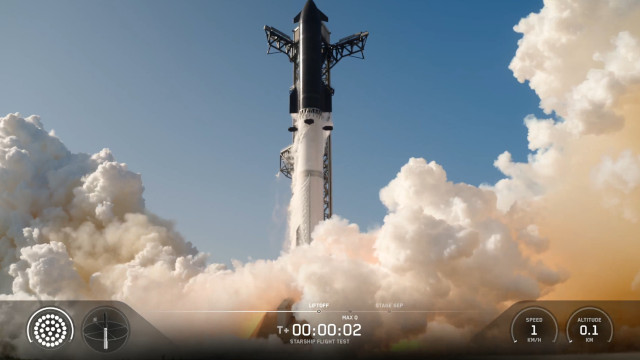
It was the afternoon in the USA when SpaceX conducted a new flight test of its Super Heavy rocket and Starship prototypes, launched from its base in Boca Chica, Texas. This is the 13th test involving the entire system of Elon Musk’s company, which is supposed to revolutionize space travel with an unprecedented transport capacity and be totally reusable. They are advanced prototypes with the Super Heavy identified as Booster 20 and the Starship identified as Starship 40 or Ship40 or simply S40. It was the second test of the vehicles in their Block 3 version.
The 12th test, conducted on May 22, was a partial success. A few issues indicated that the Raptor engines still needed to be fine-tuned, but this is a normal process of perfecting the new engine versions for these vehicles. Tonight’s test shows that this process is still ongoing.
No recovery attempt was planned for the second test with the Block 3 vehicles. The trajectory was essentially the same as the previous tests, with a splashdown of the Super Heavy in the Gulf of Mexico and a splashdown of the Starship in the Indian Ocean. The new features included reaching an altitude that would bring Starship 40 close to orbit and testing the delivery system’s deployment of actual Starlink 3 satellites.

The first phase of the flight already appears to be working well, with a successful liftoff and separation of Starship 40 from the Super Heavy 20. The caution before attempting a controlled landing of the rocket remains understandable after, once again, some engines failed to restart during the descent into the Gulf of Mexico. In the end, the splashdown was once again violent, with a crash rather than a controlled maneuver.
The Starship test went better. A crucial phase was the successful deployment of 20 actual Starlink 3 satellites. These are the new version of SpaceX’s controversial satellites that provide worldwide Internet connections. This new version is more powerful than the previous one and also more massive, which is why Starship is needed to launch them into orbit.
In this first deployment test, the Starlink 3 satellites weren’t placed into normal orbit since Starship was still conducting a suborbital flight. For this reason, the Starlink 3 satellites began to fall immediately and had little time to conduct Starlink network connection tests. The amount of debris released by the 20 Starlink 3 satellites will not help quell the controversy surrounding this constellation.
Just over an hour and five minutes after liftoff, Starship 40 splashed down in the Indian Ocean. Compared to the previous test, the controlled splashdown was a complete success. All collected data must be carefully examined, but it appears that a number of issues that had plagued Starship have been resolved.
As always, the date of a new test depends on the time required to review the collected data and resolve any issues encountered while fine-tuning the Raptor 3 engines. Overall, the 13th test was a success, so it’s possible SpaceX will begin testing with orbital flights.

