
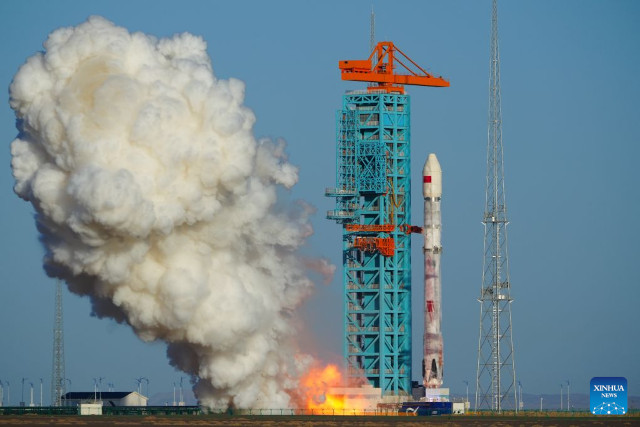
A few hours ago, the Chinese Zhuque-3 Y2 rocket blasted off from the Dongfeng commercial area, carrying the Honghu-03 satellite. The second stage successfully reached orbit with payload separation, achieving a successful primary mission on this rocket’s second flight, the first to deploy a real satellite into orbit. A goal for LandSpace, the company that developed the rocket, was to land the first stage, which was successful on this second attempt.
For a few years now, China has taken the goal of developing at least partially reusable rockets very seriously, and there are three Chinese partially reusable rockets in various stages of development. The Zhuque-3 rocket’s maiden flight, which took place on December 3, 2025, was a partial success, meaning the primary mission was successful, but the first stage failed to land due to an anomaly during its reentry maneuvers.
The Zhuque-3 rocket can be compared to the Falcon 9 in terms of its size and payload-to-orbit capacity. The big difference is that it uses methane and liquid oxygen engines, like SpaceX’s Super Heavy and Blue Origin’s New Glenn.
The Zhuque-3 Y2 rocket accomplished a mission that was real in every respect. The Honghu-03 satellite was deployed into low Earth orbit, achieving a successful primary mission. However, SpaceX has clearly proved the advantages of a company with the ability to reuse at least the first stage of its rocket, so this mission was an important test for LandSpace.
The first stage of the Zhuque-3 Y2 rocket successfully landed on the LandSpace pad in Minqin County, Gansu Province. In this respect, it’s very similar to the Falcon 9 rocket, in that the first stage uses only its own engines for braking and has a leg system that extends upon landing on the pad.
This success follows the landing of the Long March-10B rocket’s first stage on July 10. These are truly significant achievements for China, but now it will be necessary to prove the ability to quickly overhaul the recovered first stages for reuse. SpaceX took some years to develop a quick reuse system. China’s space program is ambitious and requires reusable rockets for its next phases. In the case of the Zhuque-3 rocket, it’s also planned to launch the Haolong cargo spacecraft, currently under development.

