
An article published in the journal “Nature Astronomy” reports the results of a study on the formation of jets of materials by black holes, identifying a rule that appears to be independent of their mass. Adelle Goodwin of the Curtin University’s International Centre for Radio Astronomy Research, Australia, and Andrew Mummery of Princeton’s Institute for Advanced Study, USA, studied a series of tidal disruption events in which black holes destroyed a star. By analyzing the collected data, the researchers concluded that all black holes emit powerful jets of material at the same stage of their accretion cycle, a stage linked solely to the rate at which the black hole feeds, rather than its mass.
The authors sought to solve a mystery regarding why some supermassive black holes emit jets of material after tearing apart a star that ventured too close, while others remain dormant, only to emit jets months or even years later. Since these jets can influence the evolution of the galaxies hosting the black holes, the mystery was far from trivial.
The notion that black holes—whether stellar remnants or supermassive black holes—follow the same rules was nothing new. The challenge, however, was that supermassive black holes undergo evolutionary processes spanning at least millennia, if not millions of years, making it impossible to track their accretion cycles. This doesn’t apply to every such cycle, as tidal disruption events generate cycles lasting only a few years.
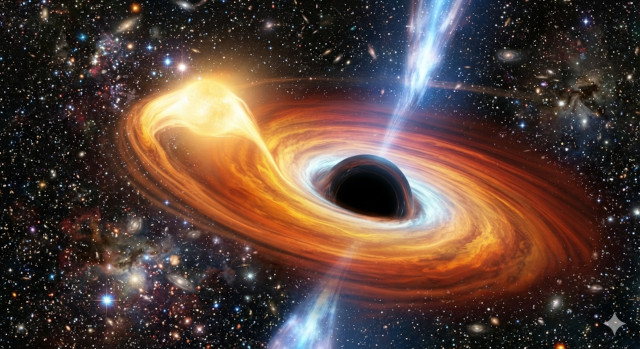
In a tidal disruption event, a star that strays too close to a black hole is destroyed by its gravity. Part of the star is swallowed, while another portion forms an accretion disk around the black hole. Some of the gas that originally made up the star is ejected in jets from the black hole’s poles. These jets collide with interstellar gas, generating radio emissions that can be detected and help to reconstruct the history of those events.
Adelle Goodwin and Andrew Mummery analyzed twenty tidal disruption events using observations conducted not only in the radio band but also in other electromagnetic bands to obtain the most complete picture possible. Eleven of these events provided sufficient data to gain the information sought. The analysis results were also compared with relativistic models of the accretion disks surrounding the supermassive black holes at the center of the study.
The two researchers identified two distinct phases during which supermassive black holes eject material during a tidal disruption event. The first phase occurs early in the event, as the accretion disk rapidly increases in size. The second phase occurs much later—hundreds or even thousands of days after the star is torn apart—when the accretion rate has dropped significantly. Jet formation is triggered only at this point, a threshold previously observed in stellar-mass black holes.
Simulations of tidal disruption events involving stars and black holes with varying characteristics indicate that the disk accretion rate is the deciding factor. In some cases, the accretion of the disk of materials quickly reaches the threshold required to produce jets, whereas in others, years may pass before this happens.
The simulation results are confirmed by observations. These findings can be tested against predictions of supermassive black hole behavior during future tidal disruption events as they are detected. Observations can be scheduled to capture the most significant events. This will help to understand the details of the processes occurring around supermassive black holes and their impact on their host galaxies, as well as provide a means to test astrophysical models.
