
February 2015

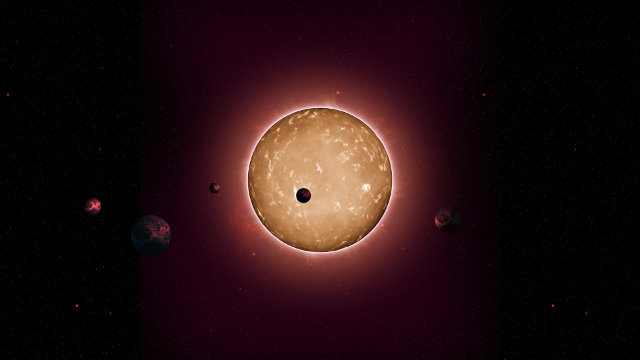
Artistic concept of the Kepler 444 system (Image Tiago Campante/Peter Devine)

Using data collected by the Kepler space telescope, a group of researchers led by asteroseismologists from the University of Birmingham discovered five planets orbiting the star Kepler-444. They’re small rocky planets: the smallest has a size similar to Mercury, the largest has a diameter about three-quarters of the Earth. Another special feature is that the star Kepler-444 is very ancient, with an age estimated to around 11.2 billion years.

Planck view of BICEP2 field (Image ESA/Planck Collaboration. Acknowledgment: M.-A. Miville-Deschênes, CNRS – Institut d’Astrophysique Spatiale, Université Paris-XI, Orsay, France)

In March 2014, the announcement that the BICEP2 (Background Imaging of Cosmic Extragalactic Polarization) experiment had detected gravitational waves in the perturbations in the cosmic microwave background radiation existing in the universe was sensational. This echo of cosmic inflation occurred shortly after the Big Bang was an extraordinary discovery. Unfortunately, a collaboration between the BICEP2 experiment and the team of ESA’s Planck space telescope has determined that those weren’t gravitational waves but probably emissions caused by galactic dust.