
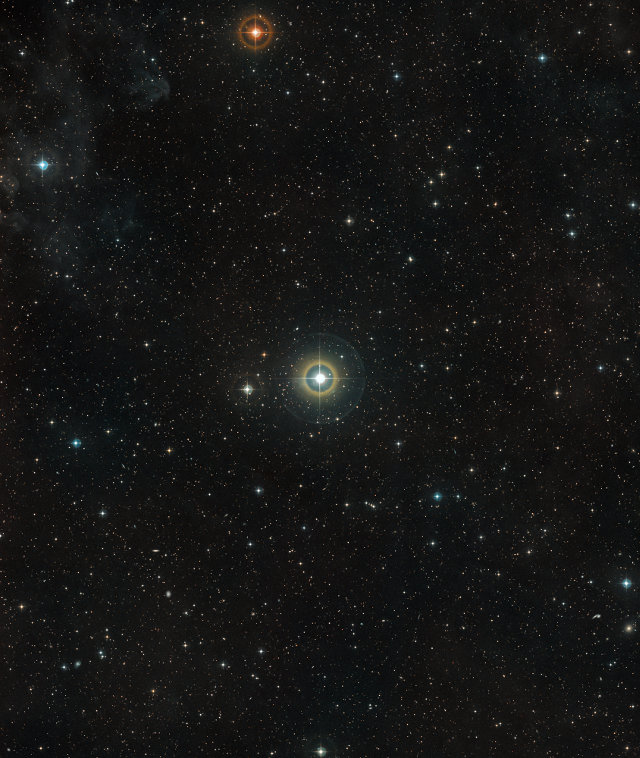
A team of astronomers used the HARPS (High Accuracy Radial velocity Planet Searcher) instrument at ESO’s La Silla Observatory in Chile to obtain for the first time a direct detection of the spectrum of visible light from an exoplanet. It’s 51 Pegasi b, already well known by astronomers because it was the first exoplanet discovered among those orbiting a star on the main sequence.
The star 51 Pegasi is about 50 light years from Earth and has a mass slightly greater than the Sun’s. In the ’90s, when there were the first successes in the search for exoplanets, the first ones were discovered orbiting a pulsar, which is what can remain after a star’s death. 51 Pegasi is instead in its main sequence, the normal life span of a star. The exoplanet 51 Pegasi b was the first to be discovered orbiting a normal star in 1995.
The planet 51 Pegasi b is of the hot Jupiter type, a gas giant very close to its star. In this case, it’s closer to it than Mercury is to the Sun. For this reason, it’s heated to a temperature estimated at about 1,000° Celsius (about 1,800° Fahrenheit). The discovery of such a planet was surprising but the discoveries of the past 20 years show that they’re quite common.
This exoplanet got back to the spotlight now because it’s been observed again with a new technique that allows to detect the spectrum of visible light. This technique uses the spectrum of the parent star as a model for finding a signature of similar light reflected by the planet.
It’s a type of research very complex because the light reflected by a planet is extremely dim compared to that emitted by its host star. Around an exoplanet there may be many other sources of noise, a kind of electromagnetic pollution caused by various sources in the sky. It’s therefore necessary to eliminate these sources that have light traces different from those sought.
Despite the difficulties, the experiment carried out by the team of astronomers led by Jorge Martins from the Instituto de Astrofísica e Ciências do Espaço (IA) and the Universidade do Porto, Portugal, with the planet 51 Pegasi b was successful. This result is excellent considering the fact that it was obtained using the ESO 3.6-meter Telescope, which has a limited range of applications with this technique.
This type of direct observation doesn’t require that the planet transits in front of the parent star, as in the most commonly used method. The direct vision of an exoplanet also allows to obtain more information about it. In the case of 51 Pegasi b, astronomers found that its mass is about half that of Jupiter’s but its diameter is greater. This is due to the fact that is very hot so the gases that compose it are dilated. That’s normal for a hot Jupiter.
In the future, this new technique can be applied with better results using more advanced instruments. For example, it will possible to use the VLT (Very Large Telescope) ESO and later the E-ELT (European Extremely Large Telescope), whose construction began last year.
Instruments such as the ESPRESSO (Echelle SPectrograph for Rocky Exoplanet and Stable Spectroscopic Observations) spectrograph on VLT and E-ELT will allow to achieve greater accuracy and an increase of the collection area. This will facilitate the detection of exoplanets smaller and generally get more details. Some thousands of exoplanets have already been discovered, with this technique it will be possible to find more of them and get more information about them.
[ad name=”eBayUSUKAstronomy”]
