April 2015

NASA is studying the presence of water in the solar system and beyond also in connection with the search for alien life form (Image NASA)

Yesterday in Washington, D.C. there was a NASA panel about water and its connection with the possibility of finding extraterrestrial life. Some scientists summarized the findings of recent decades obout the presence of water in space and exoplanets. According to Ellen Stofan, chief scientist at NASA, in the course of our life we ​​may finally have an answer whether we are alone in the solar system and beyond.

The ATLAS catching the particle "splashes" when one of the first beams passed through the Large Hadron Collider (Image courtesy CERN. All rights reserved)

This Easter represented for CERN the time of the Large Hadron Collider (LHC) full operation restart. After the testing that began a few weeks ago, in the morning of last Sunday a proton beam has covered all 27 kilometers (about 17.7 miles) of the giant ring. After less than two hours, a second beam was sent in the opposite direction. The energy was “only” 450 GeV but it was a major event for the restart of the scientific activity.

Images of eight galaxies containing green filaments that are the last effect of ancient quasars (Image NASA, ESA, and W. Keel (University of Alabama, Tuscaloosa))

The Hubble Space Telescope photographed a series of ghosts of quasars that existed in the past. They are seen as ethereal green objects in various forms and are the last effects of ancient quasars. These phenomena are very interesting from a scientific standpoint because they can provide information about the past of those galaxies, which were once very active.

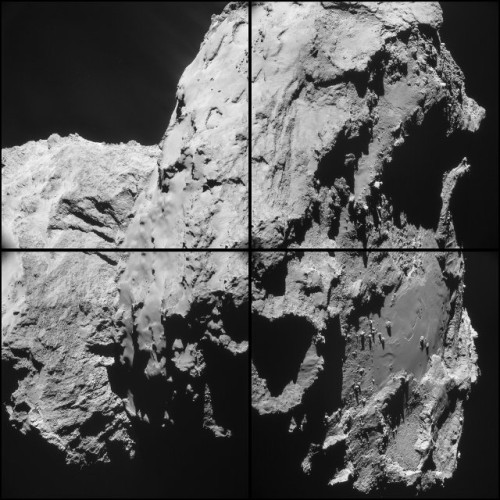
Four image montage of pictures of the comet 67P/Churyumov–Gerasimenko taken by the space probe Rosetta (Image ESA/Rosetta/NAVCAM)

During the past weekend, ESA’s space probe Rosetta has taken a new flyby about 14 kilometers (about 8.6 miles) away from the comet 67P/Churyumov-Gerasimenko. This means that it hasnt come as close as in February, however, the comet’s increasing activity caused some problems in Rosetta. Among the consequences, it had serious difficulties in communicating with ESA’s mission control.