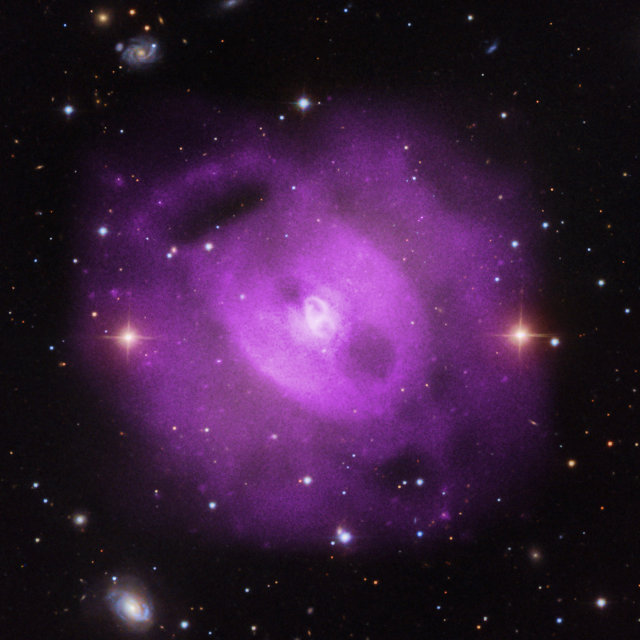
An article in “The Astrophysical Journal” describes a research group of NGC 5813 made using the NASA’s Chandra X-ray Observatory. In this galaxy group, multiple eruptions originate from the supermassive black hole at the galactic center that gives its name to the group were discovered. This activity took place over about 50 million years and has changed the appearance of the group, creating various cavities, huge bubbles within the cloud of hot gas that surrounds it.
Galaxy groups are smaller “cousins” of galaxy clusters and typically consist of 50 or fewer galaxies. The group of NGC 5813 has a distance of about 105 million light years from Earth and the activity of the supermassive black hole in the central galaxy that gives its name to the group was studied using Chandra X-ray Observatory.
The gas cloud that envelops the group of NGC 5813 was pierced by the activity of the supermassive black hole. Part of the materials that fall towards it isn’t swallowed but accelerated by its magnetic field at speeds approaching that of light generating two huge jets that move away in opposite directions from its poles.
These jets cause pairs of cavities in the gas cloud enveloping the group of NGC 5813 and the research shows three pairs of cavities that correspond to three major eruptions of the supermassive black hole. X-ray observations made using Chandra were combined with other at visible light in order to have a complete picture of the situation.
The cavities were studied to understand the length of the eruptions of the supermassive black hole. The researchers found that the energy needed to create the pair of cavities closest to the black hole is lower than that needed to create the other pairs. However, the measured power is the same for the three pairs. This indicates that the eruption associated with the inner pair is still in progress.
Each pair of cavities is associated with a shock front, visible as sharp edges in the X-ray image. The shock fronts heat the gas by preventing them from cool down and forming large amounts of new stars. A close study of the shock fronts shows that the edges are not so sharp, probably because of turbulence in the hot gas.
Eruptions like those that occur in the supermassive black hole in the group of NGC 5813 are immense phenomena, affecting an entire group of galaxies. They are very spectacular but are also crucial for the future of the galaxies involved. The fact that the gases can’t form many new stars change their evolution in a remarkable way.
