
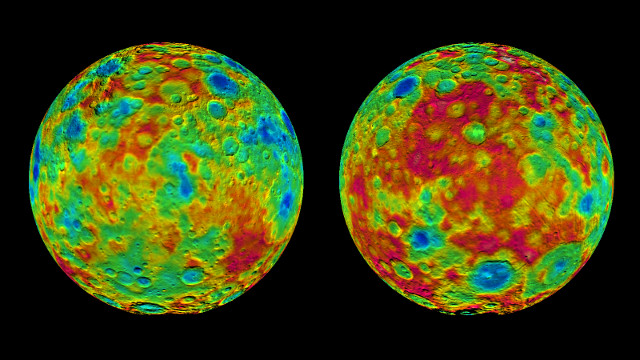
NASA published the first topographic maps of the dwarf planet Ceres made using data collected by its Dawn space probe. They show a very diverse surface, full of craters and mountains with differences between the bottom of the craters and the mountain peaks that can reach 15 kilometers (about 9 miles). Meanwhile, the IAU (International Astronomical Union) approved a series of names for various geological features of Ceres.
The Dawn space probe recently started the maneuvers needed to make a more precise mapping of the dwarf planet Ceres but the data available so far allowed to produce good quality maps to study it. Scientists found craters with characteristics similar to those existing on Dione and Tethys, two icy satellites of Saturn similar in size and density to Ceres.
The scale of the colors used to mark the levels in the image range from indigo for the one 7.5 km (about 5 miles) below the surface level to white for the one 7.5 km (about 5 miles) above the surface level. Paul Schenk, a geologist of the Lunar and Planetary Institute, Houston, and a member of the Dawn mission’s scientific team, pointed out that these topographical elements are quite consistent with an ice-rich crust.
The images captured so far by the framing camera, one of the Dawn space probe’s instruments, were used to build these maps. The scientists analyzed the images taken from various angles combining them into an orthographic projection, which depicts a hemisphere as it appears from space.
Those are preliminary maps, waiting for the much better ones that will be created in some months. They also allow you to mark the first names of various features, inspired by various spirits and deities related to agriculture taken from various cultures. This choice is due to the fact that Ceres was the Roman goddess of agriculture.
For the new mapping of Ceres, the Dawn space probe is coming down to an altitude of less than 1,500 km (about 900 miles), about one-third that of its previous orbit. The thrust of its ion engine is weak so it will take a couple of more weeks to reach the new orbit. Around mid-August it will start collecting new images and other data to know Ceres even better.
[ad name=”eBayUSUKAstronomy”]
