
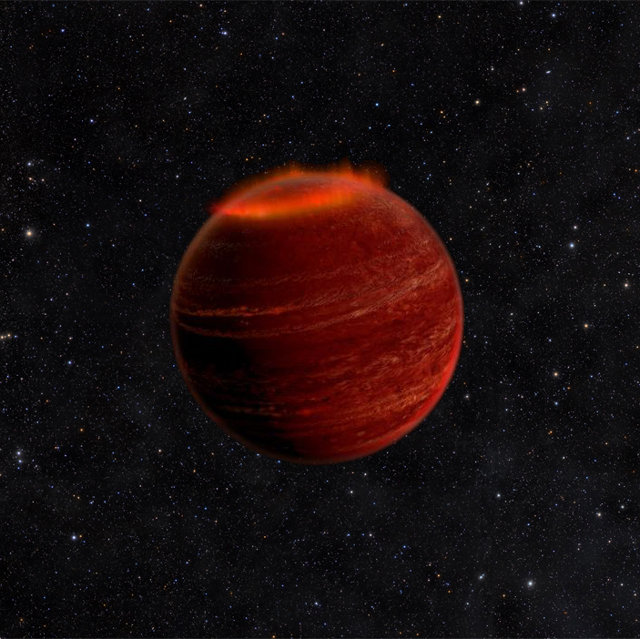
Its aurora is 10,000 times more powerful than any other ever seen, somuch as to be detectable, although with very sophisticated instruments, from a distance of 18 light years. It was found on a brown dwarf called LSR J1835+3259 using the Karl G. Jansky Very Large Array (VLA), the Hale Telescope in California and the Keck Telescope in Hawaii. The results of this research have just been published in the journal “Nature”.
Brown dwarfs are considered failed stars. According to a research recently published in the journal “Astrophysical Journal” and also performed using the Karl G. Jansky Very Large Array (VLA) they are formed like normal stars, at the center of a disk of gas and dust. However, their mass is not enough to trigger the thermonuclear reactions that make the stars so bright.
At the beginning of the last decade, when the first brown dwarfs were just discovered, astronomers started detecting radio emissions from them. In 2006, Gregg Hallinan, assistant professor of astronomy at the California Institute of Technology (Caltech) in Pasadena, who led the research on LSR J1835+3259, discovered that brown dwarfs could pulse at radio frequencies. Those pulses are similar to what you can see in the planets of the solar system that have auroras.
Leon Harding of NASA’s Jet Propulsion Laboratory and co-author of this research, discovered that there is a periodic variation in the optical wavelengths coming from the brown dwarfs that pulse radio frequency. To look for changes in light intensity of celestial bodies and examine this phenomenon, he built an instrument called a optical high-speed photometer.
Putting together the various results, the scientists wondered if this variation was caused by auroras. The magnetic activity detected on the brown dwarf LSR J1835+3259 can actually be explained by the presence of auroras much more powerful than the ones we can see in the solar system, even on Jupiter.
At this point, the origin of that aurora remains to be explained. A brown dwarf isn’t receiving a solar wind that can cause it as it happens on Earth. The atmosphere around a brown dwarf could support that activity. Another possibility is that a planet orbits within the magnetosphere of the brown dwarf generating an electromagnetic current and consequently an aurora.
Further studies on LSR J1835+3259 and other brown dwarfs with auroras will help to solve the mystery. This research will also help to study exoplanets because in many ways brown dwarfs are more similar to giant planets than stars but their observations are not disturbed by the light coming from a real star nearby.
[ad name=”eBayUSUKAstronomy”]
