
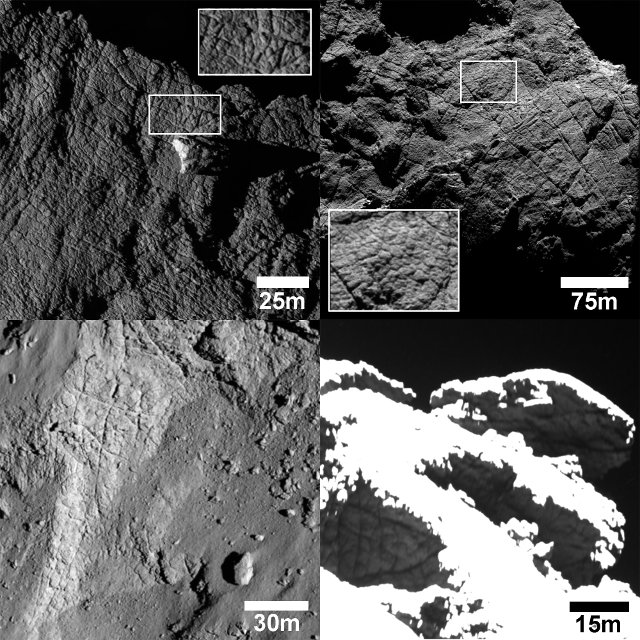
While the comet 67P/Churyumov-Gerasimenko started moving away from the Sun, new studies have been published based on data collected over the past months. An article published in the journal “Geophysical Research Letters” describes the exam of the many fractures photographed after the arrival of ESA’s space probe Rosetta. Another article published in the journal “Annales Geophysicae” provides an explanation for the “song” of the comet discovered last year.
A team of researchers led by M. Ramy El-Maarry of the University of Bern examined images of the comet 67P/Churyumov-Gerasimenko taken between August 6, 2014, when the Rosetta space probe reached it, and March 1, 2015. They include photographs taken a few kilometers away from its surface. In particular the many fractures were examined.
The researchers identified three types of fractures: narrow with a network pattern, on cliffs and fractured rocks. The network ones are the most widespread and may extend from a few meters up to lengths of 250 meters, typically on relatively flat surfaces.
In some areas the fractures seem to cross cut each other in polygonal patterns at angles of 90°. On Earth and Mars this is often an indicator that there’s ice under the surface that contracted. Other types of crossed fractures were identified on cliffs, for example in the region called Seth.
According to the scientists, most of these fractures are most likely linked to thermal stress. When the comet 67P/Churyumov-Gerasimenko approaches the Sun, ice sublimates resulting in a loss of material. However there are also large variations in temperature on the surface and in underground that cause contractions and expansions of the ground and the resulting fractures.
Another research conducted by scientists who run the instruments of the Rosetta Plasma Consortium (RPC) focused on the “song” emitted by the comet 67P/Churyumov-Gerasimenko. Last year, the scientists became aware of the emission of an oscillation in the magnetic field of the comet environment. It was “sung” at 40-50 milliHertz, well below the perception of the human ear but detectable by RPC.
The sounds emitted by the comet 67P/Churyumov-Gerasimenko are caused by the interaction between the plasma emitted by the Sun and the comet’s gas and dust atmosphere generated by ice sublimation. Although the comet’s nucleus doesn’t have a magnetic field, the atmosphere or the coma can be magnetized.
During the approach of the comet 67P/Churyumov-Gerasimenko to the Sun, its activity increased. The consequence is that the interaction between the plasma from the Sun and the increasingly dense atmosphere became more violent. The “song” was still present but mixed with other phenomena. Data exams continue.
[ad name=”eBayUSUKAstronomy”]

Permalink