
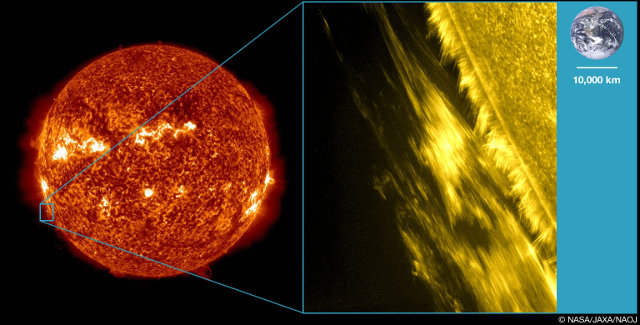
An explanation to the mystery of the solar corona heating
Two articles published in “The Astrophysical Journal” describe a study of what is known as the coronal heating problem. For decades, scientists have been trying to understand why the temperature on the surface of the Sun is about 6,000 Kelvin while the corona, the region between the surface and the area of the outer atmosphere, can reach temperatures of several million degrees. Now a team of researchers led by Takenori Okamoto of the Solar-Terrestrial Environment Laboratory at Nagoya University and ISAS/JAXA and Patrick Antolin of the National Astronomical Observatory of Japan, Tokyo, offers an explanation, tied to resonant absorption.
