August 2015

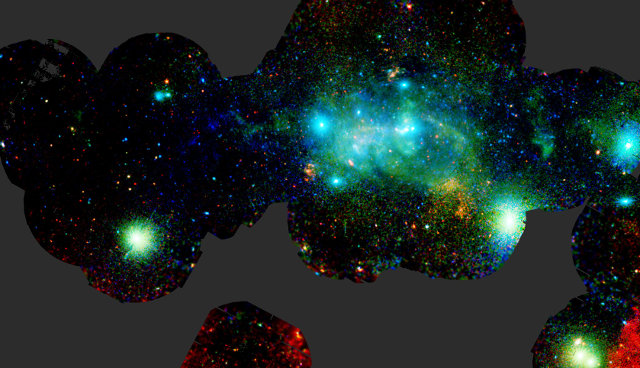
X-ray view of the Milky Way center (Image ESA/XMM-Newton/G. Ponti et al. 2015)

An article published in the journal “Monthly Notices of the Royal Astronomical Society” describes a research about the central region of the Milky Way. Using ESA’s XMM-Newton X-ray space observatory, a team of scientists from the Max Planck Institute for Extraterrestrial Physics (MPE) led by Dr. Gabriele Ponti revealed the most intense processes going on at the center of the galaxy.

Examples of the fractures detected on the surface of the comet 67P/Churyumov-Gerasimenko (Image ESA/Rosetta/MPS for OSIRIS Team MPS/UPD/LAM/IAA/SSO/INTA/UPM/DASP/IDA)

While the comet 67P/Churyumov-Gerasimenko started moving away from the Sun, new studies have been published based on data collected over the past months. An article published in the journal “Geophysical Research Letters” describes the exam of the many fractures photographed after the arrival of ESA’s space probe Rosetta. Another article published in the journal “Annales Geophysicae” provides an explanation for the “song” of the comet discovered last year.

The InSight lander in its protective aeroshell during the test stage (Photo NASA/JPL-Caltech/Lockheed Martin)

NASA invited people around the world to participate in an initiative to send your name to Mars. You just need to record some data on the page prepared by the Agency on its website to get a virtual boarding pass. All names will be recorded on a microchip that will be transported on the InSight lander, which is scheduled to be launched in March 2016 to land on Mars in September 2016.

Picture of the galaxy NGC 428 taken by the Hubble Space Telescope (Photo ESA/Hubble and NASA and S. Smartt (Queen's University Belfast))

A photograph of the galaxy NGC 428 taken by the Hubble Space Telescope shows its distorted and warped structure. Together with traces of a significant amount of stars being formed, it’s the sign of the merger between two galaxies. For this reason, its appearance could give us an idea of ​​what will happen in a few billion years to the Milky Way in its merger with Andromeda.