
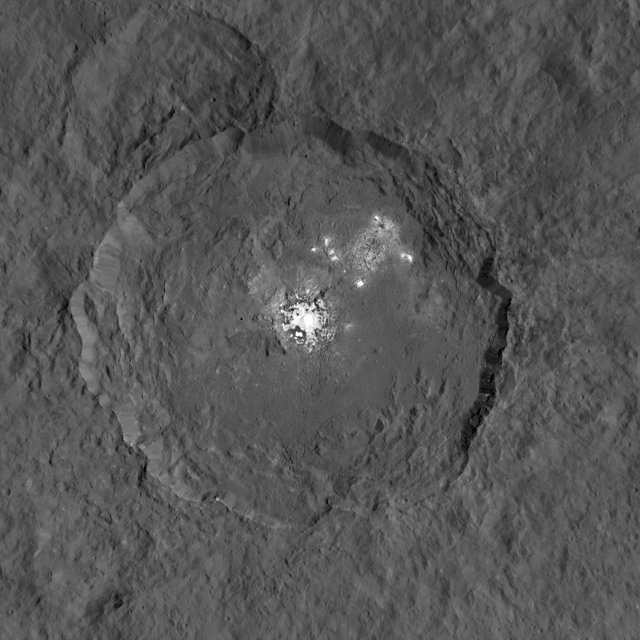
NASA has released a new image of the now famous white spots of Ceres, one of the most mysterious geological features found on this dwarf planet. The Dawn space probe is currently mapping its surface from an altitude of 1,470 km (915 miles) and that allowed to take pictures much more detailed than the ones previously available. These new images have a resolution of 140 meters (450 feet) per pixel and are providing new information about the white spots waiting for in-depth analyzes.
The Dawn space probe has completed two mapping 11-day cycles of the surface of the dwarf planet Ceres and yesterday started the third cycle. This mapping work includes a total of six cycles, each consisting of 14 orbits. The angle changes slightly in each cycle and that gives scientists the possibility to assemble stereoscopic images and build 3D maps.
Its proximity allowed the Dawn space probe an observation of the Occator crater, in which there are the white spots, much better than the one performed in February 2015. They are much brighter than the rest of the surface of Ceres so the Dawn team combined two different images: one properly exposed for the white spots and another that instead is properly exposed for the surface around them.
These new images allow to see much better than before the borders of the central spot, the largest, and the fact that there are several other smaller spots. Their shapes, which in the previous pictures seemed quite round, are now much more uneven, especially that of the large central spot.
The main question remains, that is the nature of these white spots. Unfortunately the new photographs are not enough to establish that even if they’re useful in the research. Marc Rayman, Dawn’s chief engineer and mission director, stated that soon the scientific analysis will reveal the geological and chemical nature of the spots. Basically, we have to wait for scientists to examine the data gathered by the other instruments of Dawn.
NASA has also produced this animation in black and white and color of Occator crater topography.

Permalink
Permalink