
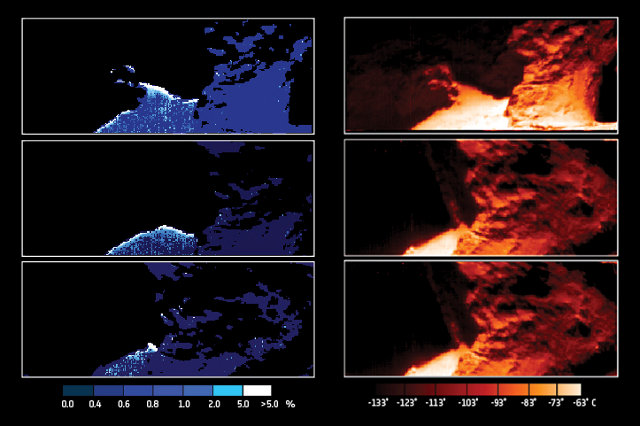
An article just published in the journal “Nature” describes a research on the daily water-ice cycle on the surface of the comet 67P/Churyumov-Gerasimenko and its vicinity. A team of scientists led by Maria Cristina De Sanctis from Rome’s IAPS-INAF (National Institute of Astrophysics – Institute for Astrophysics and Space Planetology) analyzed data collected by the ESA’s Rosetta space probe’s VIRTIS spectrometer discovering that in some areas the ice water disappears in the day and reappears in the night.
When comets approach the Sun, their nucleus heats up and various materials sublimate becoming gas. Water, but also carbon monoxide and carbon dioxide, are emitted from the comet to form its coma and its tail. The presence of ESA’s space probe Rosetta has among its aims to explain the mechanisms behind these gas emissions.
Among the Rosetta space probe’s instruments there’s VIRTIS (Visible and InfraRed Thermal Imaging Spectrometer), which allowed to observe some areas where the water ice appears and disappears in the region called Hapi, in the neck of the comet 67P/Churyumov- Gerasimenko. The ice appears when there’s shadow and disappears when the sun hits the area.
The researchers found a real water-ice cycle that occurs during the days of the comet 67P/Churyumov-Gerasimenko. It in fact has its rotation so it’s correct to speak of day. When dawn comes, the ice on the surface down to a few centimeters deep sublimates. As the hours passed, the region enters the shadowed zone and the surface cools down quickly while the layers below it take longer because they accumulated heat.
The consequence is that the ice beneath the surface keeps on sublimating for a while making their way through the internal porous structure of the rocks of the nucleus of the comet 67P/Churyumov-Gerasimenko. When it reaches the surface, which has already cooled down, the water vapor freezes again, creating a new layer that will sublimate when the Sun hits the area again.
Enrico Flamini, chief investigator of ASI (Italian Space Agency), pointed out that these evidence of the water cycle on a comet are a significant scientific discovery and a further confirmation of the unique qualities of spectrometers such as VIRTIS, built by ASI.
The data collected will allow to estimate the abundance of water ice present on comet 67P/Churyumov-Gerasimenko compared to other materials. In the Hapi region examined, in the layer down to a few centimeters of depth it accounts for 10-15% of the materials and appears to be well mixed with the other constituents.
The water vapor emitted in the area accounts for about 3% of the total water vapor emitted by the entire comet 67P/Churyumov-Gerasimenko during the period examined according to the measures taken by another instrument, MIRO (Microwave Instrument for the Rosetta Orbiter). It’s possible that the same water-ice cycle exists in other areas of the comet but for now only those of Hapi in September 2014 were analyzed. The study will continue with the analysis of data for the subsequent period to extend this kind of research.
[ad name=”AmazonScience”]

Permalink