
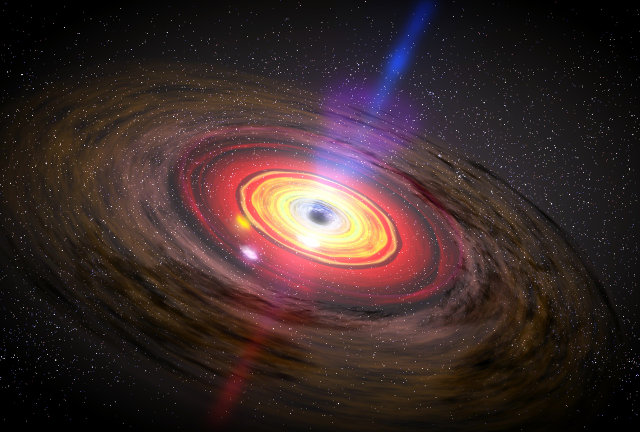
An article in the journal “Monthly Notices of the Royal Astronomical Society” describes a study of the galaxy SAGE0536AGN and in particular the supermassive black hole at its center, which is 30 times larger than expected. This is the result of measurements conducted by a team of astronomers at Keele University and the University of Central Lancashire, an anomaly all to explain.
The galaxy SAGE0536AGN was discovered in 2011 by analyzing data collected by NASA’s Spitzer Space Telescope. According to estimates, it’s at least 9 billion years old and its distance from Earth is about 2 billion light years. It contains what is called an Active Galactic Nucleus (AGN), which is believed to be the result of large amounts of heated materials spinning around a supermassive black hole eventually getting swallowed.
The AGN is very bright so the team that conducted this research used the Southern African Large Telescope to observe the broadening of the hydrogen emission line in the galaxy spectrum due to the Doppler Effect. This broadening means that the gas is moving at a high speed due to the strong gravitational field of the supermassive black hole.
Using this data, the scientists calculated the mass of this black hole. In a galaxy of the size it was expected that the supermassive black hole had a mass around 12 million solar masses. Instead, it was found to be about 350 million solar masses. The mass of the galaxy SAGE0536AGN is about 25 billion solar masses, which is about 70 times that of the supermassive black hole at its center.
According to Dr. Jacco van Loon of Keele University, lead author of the article, for this supermassive black hole it shouldn’t be possible to be so large. Normally, these black holes grow at the same rate as galaxies, this means that in SAGE0536AGN the black hole has grown much faster or that the galaxy stopped growing prematurely.
The galaxy SAGE0536AGN was discovered by accident so there may be others of the same type. Despite our increasingly powerful telescopes, our knowledge of deep space is still limited. We don’t know whether SAGE0536AGN is an anomaly or the first in a new class of galaxies so we need to keep on examining other galaxies to try to understand it.
[ad name=”eBayUSUKAstronomy”]

Permalink