October 2015

High-resolution picture of Pluto. In the upper right a part of the heart-shaped area (Photo NASA/JHUAPL/SwRI)

The journal “Science” just published the first article on the findings on the dwarf planet Pluto and its moons made thanks to NASA’s New Horizons spacecraft July 14, 2015 flyby. Alan Stern of the Southwest Research Institute (SwRI), the principal investigator of the New Horizons mission, is also the first of a long series of authors of this study that first of all stresses the extraordinary geological and morphological variety of Pluto’s system.

Two pictures of Jupiter's surface taken by the Hubble Space Telescope (Image NASA, ESA, A. Simon (GSFC), M. Wong (UC Berkeley), and G. Orton (JPL-Caltech))

The Hubble Space Telescope was used to create new maps of the planet Jupiter. Hubble’s Wide Field Camera 3 captured a series of images of the planet within the Outer Planet Atmospheres Legacy program. The aim is to produce new maps every year and in the case of Jupiter 10 hours of daily shooting made it possible to discover new phenomena including changes in the Great Red Spot.

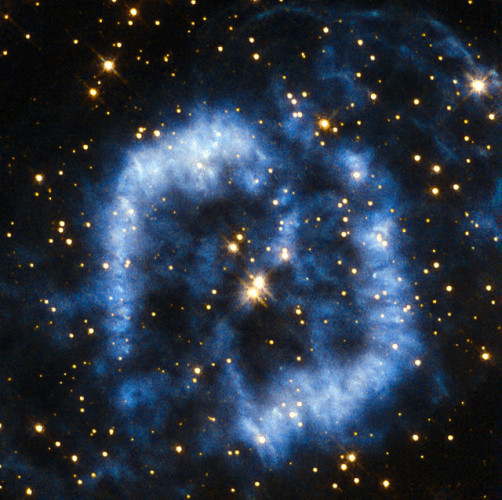
Picture of the Menzel 2 nebula taken by the Hubble space telescope (Image ESA/Hubble & NASA, acknowledgement: Serge Meunier)

The Hubble Space Telescope took a picture of the planetary nebula PK 329-02.2, also known as ESO 178-15 or Hen 2-150 and commonly called Menzel 2 (Mz 2) because it was discovered by the astronomer Donald Menzel in 1922. Distant little more 7,700 light years from Earth, it’s visible in the constellation Norma and is another case in which a planetary nebula offers a breathtaking show, in this case with a blue cloud that aligns with the two stars at its center.

Picture of the formation called Kimberley in Gale Crater taken by the Mars Rover Curiosity (Photo NASA/JPL-Caltech/MSSS)

A new study carried out by the team that runs the Mars Rover Curiosity confirmed that between 3.8 and 3.3 billion years ago there were lakes in what is now Gale Crater. At its center today there’s Mount Sharp, which foundations were formed by sediments deposited layer upon layer over a very long period. The results of this study were just published in the journal “Science”.

Pluto's blue sky (ImageNASA/JHUAPL/SwRI)

NASA published the first color photos that show the atmosphere of the dwarf planet Pluto taken by the New Horizons space probe during its July 14, 2015 flyby. The previous images showed the haze in the atmosphere but not its colors so with the arrival of the new ones it was a surprise to find that Pluto’s sky is blue. Another discovery concerns the regions of water ice detected on the surface of the dwarf planet.