
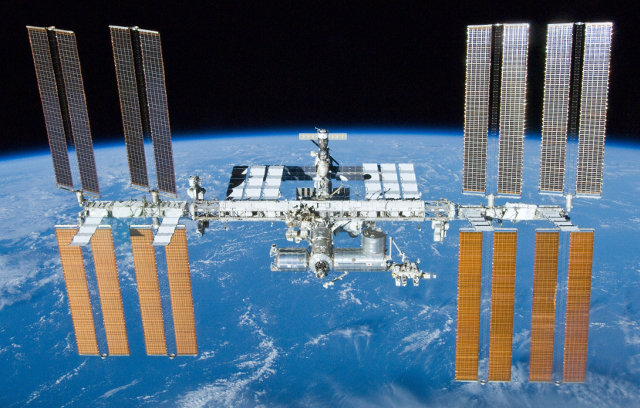
On November 2, 2000, the first three crew members reached the International Space Station to begin their work in what was then the new outpost of humanity. With that act, American astronaut Bill Shepherd and Russian cosmonauts Sergei Krikalev and Yuri Gidzenko established a continuous human presence there. Over the years, the Station has been expanded to take its current configuration, developing wider and wider opportunities to do research that have brought and will bring various technological and scientific developments.
The International Space Station is the result of an agreement born in the ’90s, when a number of projects of American and Soviet / Russian space stations were abandoned for various reasons. The USA wanted to create a new space station, but NASA was already coming to terms with budget cuts. Russia was operating the Mir space station and was already planning the Mir-2, but again, there were obstacles in the budget.
USA and Russia came to work together, also involving Japan, Canada, and the nations members of ESA. The modular structure chosen for the International Space Station assured the opportunity to build it over the years, launching a module at a time to connect it to the rest of the structure once it arrived in orbit.
Russia launched the Zarya module, the first of the International Space Station, on November 20, 1998, and the USA started launching other modules on the Space Shuttles. The arrival of a resident crew marked the beginning of the actual activities; therefore, the anniversary of that event is an important time to remember these 15 years of research. Initially, the nickname Alpha was used in various communications, but no agreement was reached to give a name to the Station, which therefore keeps on being officially called the International Space Station.
The International Space Station is a unique laboratory where they can conduct experiments that take advantage of microgravity. The research covers many fields, ranging from medicine to metallurgy. Even its crew members are guinea pigs for medical research, useful to examine issues affecting ordinary people but also to study the possibility of sending astronauts into deep space. All this work takes time, but the benefits to humanity will increase thanks to the scientific discoveries and technological developments obtained.
The future of the International Space Station is guaranteed to continue for some years, so much that Russia is supposed to add three more modules. However, a few months ago, the Russian space agency Roscosmos announced plans to build its own space station after 2024. In essence, now it’s not clear what will happen in a decade but in any case, the International Space Station can be a turning point for the history of humanity if it teach us to work together to expand our frontier but also to learn how to manage our resources rationally.
