
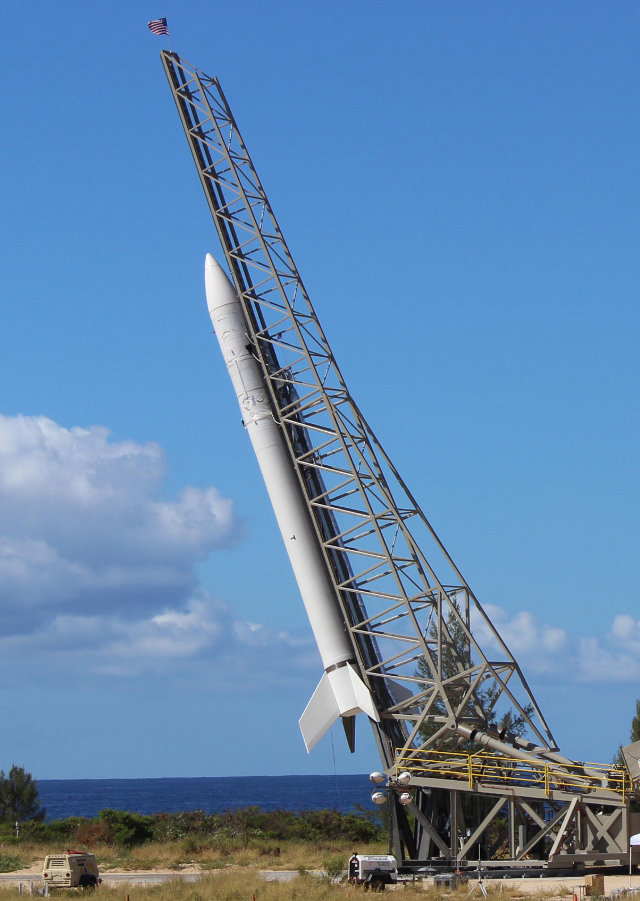
A few hours ago the first test launch of the Super Strypi rocket in the mission referred to as ORS-4 was conducted but ended in failure. The rocket regularly blasted off from the U.S. Navy’s Pacific Missile Range Facility in Kauai, Hawaii but after about a minute lost control and after a few seconds broku up with the consequent destruction of the 13 satellites it was supposed to put in orbit.
The Super Strypi rocket, also known as SPARK (Spaceborne Payload Assist Rocket – Kaua’i), is part of the LEONIDAS (Low Earth Orbiting nanosatellite Integrated Defense Autonomous System) program funded by the Department of Defense. It’s the latest development in a series of projects started in the ’60s.
Super Strypi is a small rocket only 20 meters high designed to put into orbit small satellites up to 250 kg at altitudes of about 400 km. It’s a three-stage rocket that use ammonium nitrate blend (ANB) as fuel. It requires a relatively short preparation so a launch can take place at short notice.
It’s partly a military project and for this reason there was a certain reserve around the first experimental launch but is developed in collaboration with Sandia National Laboratories, Aerojet Rocketdyne and the University of Hawaii. For this maiden launch, the payload consisted of 13 very small satellites to be launched into low Earth orbit with various civilian, scientific and even commercial aims.
It was the maiden launch of the Super Strypi rocket and for this reason the risks were known. There will be an investigation to understand the reasons for the failure of the launch. The rocket’s spin and oscillation are clearly visible in the images supplied by the University of Hawaii along with an animation that allows to better understand the movements occured before it went to pieces.
Unfortunately these things happen in the course of the development of new launchers. Because of USAF’s involvement it’s hard to know if any information will be given about the investigation on the incident. A new launch was scheduled but no dates were given and at this point the program will inevitably be revised.
