
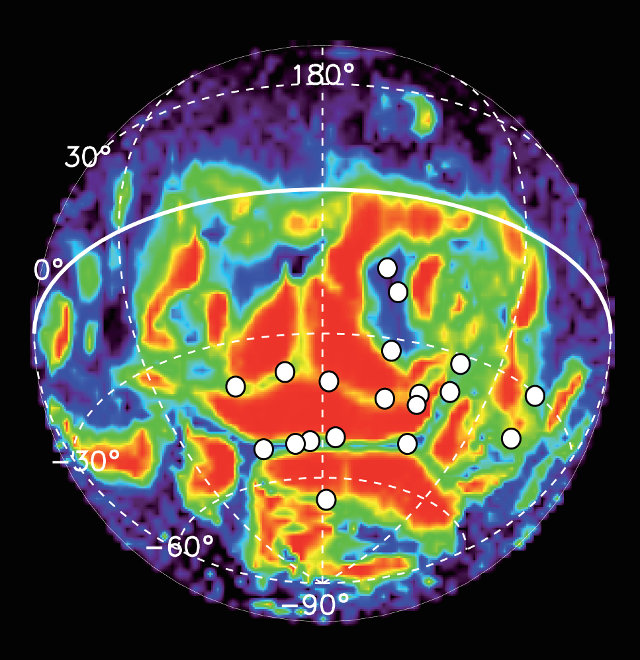
Two articles, one published in “Journal of Geophysical Research: Space Physics” and one published in the journal “Icarus”, describe a research on ultraviolet auroras detected on Mars by ESA’s Mars Express space probe. Jean-Claude Gérard and Lauriane Soret of the University of Liege, Belgium, led a team of scientists who examined ten years of data that were analyzed to understand the mechanisms of creation of these auroras.
On Earth, auroras are a common and sometimes really spectacular phenomenon but are generated by the interaction between solar wind and the Earth’s magnetic field. Mars hasn’t a magnetic field so the solar wind particles can directly affect the planet’s atmosphere to create an aurora. In fact, this phenomenon can also occur on other planets such as Venus, also without magnetic field.
Actually, in the crust of the southern hemisphere of Mars NASA’s Mars Global Surveyor space probe found a certain magnetism, a residual of the early period in which the red planet had a magnetic field. Today this magnetism is weak but is enough to increase the chances of an aurora.
The Mars Express spacecraft reached Mars in 2003 and was the first to observe an ultraviolet aurora, a rare and transient phenomenon. Over the years, this type of aurora has been observed for a total of 19 times. At the end of the last year, this phenomenon was also detected by NASA’s MAVEN spacecraft.
The Mars Express space probe’s SPICAM (Spectroscopy for the Investigation of the Characteristics of the Atmosphere of Mars) ultraviolet spectroscope was used to detect auroras. Another instrument, the ASPERA (Analyzer of Space Plasma and Energetic Atoms / Electron Spectrometer) spectrometer, allowed to analyze the energy of the electrons that hit Mars atmosphere.
Putting together all the data, the researchers discovered that auroras appear only in special conditions in specific areas related to the residual magnetic field existing on Mars. It guides the energetic electrons, which are accelerated to interact with the carbon dioxide molecules in the atmosphere. The result is an ultraviolet aurora.
The conclusion of this research is that this type of aurora is closely related to the residual magnetism present in the Martian crust. Therefore, it’s a different phenomenon from auroras observed on other planets. The analysis of the data collected by the Mars Express space probe allowed a better understanding of a phenomenon that was part of the surprises that came from Mars.
