

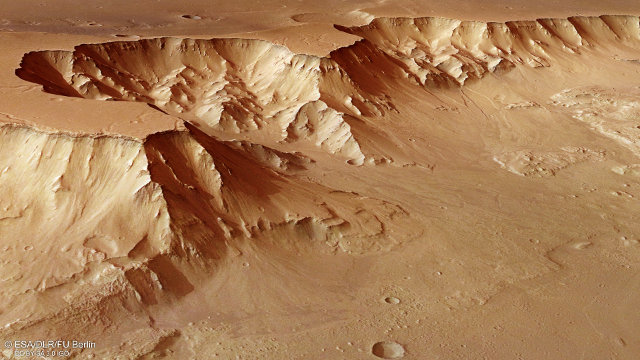
ESA has published images of Valles Marineris on Mars captured by its Mars Express space probe in July 2015. It’s a huge complex of geological fractures much wider and longer than the American Grand Canyon. In particular, scientists focused on the photographs taken by Mars Express’ High Resolution Stereo Camera (HRSC) in an area called Aurorae Chaos, where there are still traces of ancient water flows.
Aurorae Chaos is an area that extends for over 700 km (about 440 miles) with peaks and canyons. Near the junction with various canyons called Ganges, Capri and Eos Chasmata there’s a region that shows the characteristics that form when the surface collapses due to ice below the surface melting and the subsequent release of water.
The tracks of the flowing water include flood deposits, slopes and cliffs with landslides especially visible in the perspective view. It’s a chaotic terrain where tectonic events such as volcanic activity could have occurred. The picture shows only a small part of a system of interconnected valleys with flood channels that brought water into the northern plains. Probably they were active in the first 1-2 billion years of Martian history.
The interest for this region is given precisely by the fact that the traces suggest that in the distant past large masses of water flowed there. The traces of melting ice can be explained by the heat generated by volcanoes but also by the impact of an asteroid, a fairly common event in the early history of the solar system.
This analysis of Aurorae Chaos follows closely that of another area of the red planet called Mangala Valles, again thanks to the photographs taken by the Mars Express space probe. ESA scientists, and not only them, are examining various areas of Mars to improve their understand of its history. In particular, the interest concerns the presence of liquid water, abundant in the distant past, and the events that turned a planet that was similar to the Earth into the current one.

Permalink