
An article published in the journal “Nature Communications” offers an explanation to the loss of carbon in the planet Mars’ atmosphere. A team of scientists from CalTech (California Institute of Technology) and NASA’s Jet Propulsion Laboratory studied the available data focusing on the problem of carbon because what remained is less than expected even taking into account the recent results on the red planet’s atmosphere loss.
A research recently offered a convincing explanation of solar wind’s role in the planet Mars’ atmosphere loss. However, there was still the mystery of the carbon loss because scientists still expected to find a larger amount of it, also in the compounds that make up Martian rocks. It was also necessary to explain the ratio between the various isotopes of carbon on the red planet.
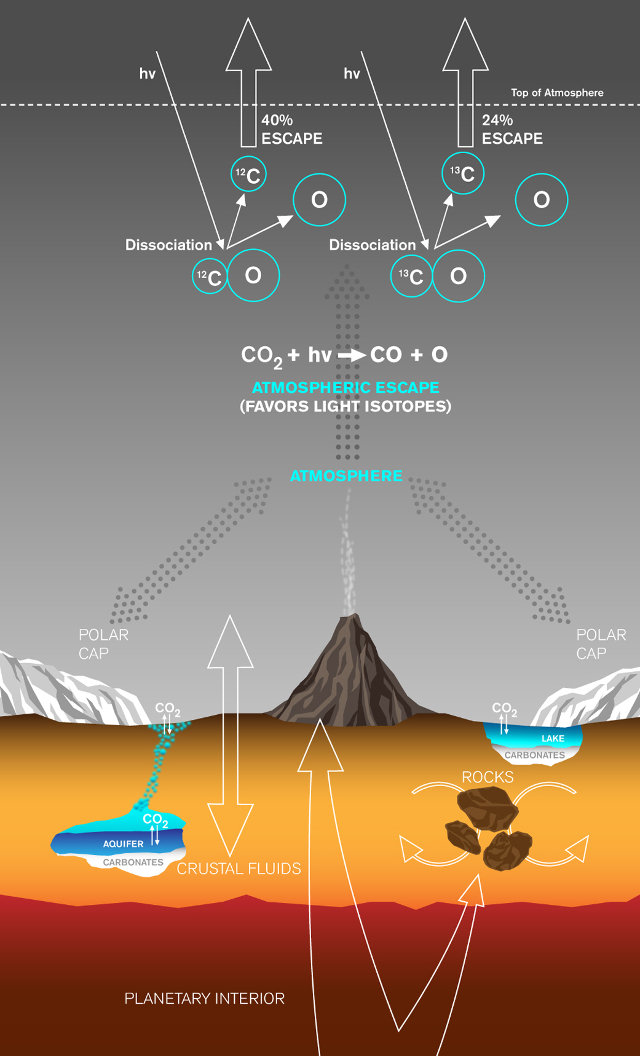
This new research focused on carbon was carried out by a team led by Renyu Hu of CalTech, based on data collected by NASA’s Mars Rover Curiosity and MAVEN space probe. The loss of atmosphere caused by the solar wind may have slightly favored the loss of carbon-12 compared to carbon-13, which is just a little heavier.
However, measurements of the Mars Rover Curiosity show that today in the Martian atmosphere the amount of carbon-13 is much greater than that of carbon-12 and this suggested that there was another process to cause this imbalance. The possibility that carbon was combined with other elements to form substances that make up the rocks was ruled out thanks to a specific search.
The data collected by various space probes allowed to make a kind of inventory of carbonates – a type of carbon compounds – which are present on Mars surface. The conclusion was that on the upper kilometer (a little more than half a mile) of the Martian crust there’s not enough carbon to explain that disappeared from the atmosphere.
The explanation offered by this new research for the loss of carbon is based on a process based on an interaction with ultraviolet rays from the Sun. When they strike a molecule of carbon dioxide in the upper layers, they break it into carbon monoxide and oxygen. Subsequently, they hit the carbon monoxide breaking it into carbon and oxygen. According to this study, carbon-12 can get lost in space much more easily than carbon-13.
By calculating the amount of carbon lost, the researchers concluded that about 3.8 billion years ago, Mars had an atmosphere pressure slightly lower than that of the Earth. These calculations will be refined using the data that keep on being collected by the MAVEN space probe but it’s already another step forward in the understanding of Mars history.
[ad name=”AmazonScience”]
