
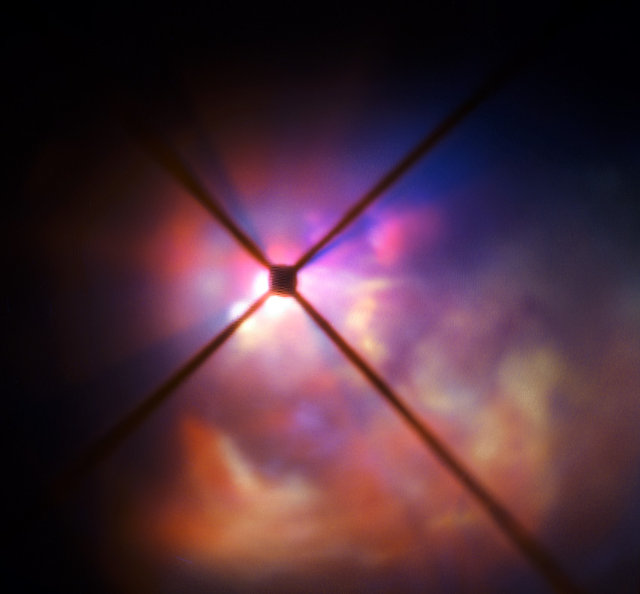
An article published in the journal “Astronomy & Astrophysics” describes a study on the star VY Canis Majoris, one of the largest in the Milky Way. The SPHERE instrument installed on ESO’s VLT (Very Large Telescope) allowed to obtain very detailed images of this star making it possible to study the dust that surrounds it and the considerable mass it loses in time ejecting it.
VY Canis Majoris is a star distant about 3,900 light-years from Earth of the hypergiant type, a term used to describe an extremely high-mass star. In particular, it’s a red hypergiant with a mass estimated at around 30-40 times that of the Sun and 300,000 times brighter. It’s a star that is reaching the end of its life.
Over the years there have been various estimates of the size of VY Canis Majoris, a task made difficult by the fact that the upper layer of a star of this kind has a very low density and is in a phase of change. Currently, this star is estimated to have a size close to that of the orbit of the planet Jupiter.
A team of astronomers used the SPHERE instrument, activated in 2014 with the main purpose of finding exoplanets but also very useful for studies such as that of the star VY Canis Majoris. In this case, its subsystem ZIMPOL was used, a camera that among other things can detect light from the disk of dust around a star.
The astronomers observed the cloud of gas and dust around VY Canis Majoris and also how the light was polarized by the material that surrounds it. Thanks to these detections, they discovered the characteristics of the dust, which was found to be composed of grains around the 0.5 micron in diameter. They’re relatively large because the dust in interstellar space generally has a diameter of around 0.01 microns.
Stars such as VY Canis Majoris eject matter for a mass about 30 times that of the Earth every year. When the star explodes in a supernova, or perhaps even in a hypernova, part of the dust will be destroyed while another part will be projected into interstellar space. In the distant future, at least part of the dust will help create new stars.
The study of VY Canis Majoris allowed to understand better how the materials of giant stars’ upper layers are ejected into space. Thanks to a sophisticated instrument such as SPHERE it was possible to find that the dust grains thrown in space are big enough to be pushed by radiation pressure. That’s the pressure exerted on a surface exposed to electromagnetic radiation, in this case, generated by the star.
VY Canis Majoris might explode at any moment and actually may already have exploded centuries ago but its light has yet to reach Earth. It will be an amazing show because it could have the brightness of the full Moon. It’s very interesting from the scientific point of view because it provides clues about the life of giant stars, which feed new generations of stars. The Sun could have been born thanks to the material ejected from very ancient stars like VY Canis Majoris.

Permalink