2015

The Tarantula Nebula with the PSR J0540-6919 and PSR J0537-6910 pulsars circled (Image NASA's Goddard Space Flight Center; background: ESO/R. Fosbury (ST-ECF))

An article published in the journal “Science” describes the study of the first gamma-ray emitting pulsar discovered outside the Milky Way. Cataloged as PSR J0540-6919, it’s part of an area full of stars known as the Tarantula Nebula or 30 Doradus within the Large Magellanic Cloud, a small satellite galaxy of the Milky Way. The gamma rays emission from this pulsar was identified by the LAT (Large Area Telescope), one of the instruments of the Fermi gamma-ray space telescope.

V774104 (Foto cortesia Subaru Telescope by Scott Sheppard, Chad Trujillo, and David Tholen. Tutti i diritti riservati)

At the 47th Annual Meeting of the American Astronomical Society’s Division for Planetary Sciences in National Harbor, Maryland, the discovery of a celestial body called for now only V774104 was announced. Using the Subaru Telescope in Hawaii, a team led by Scott Sheppard of the Carnegie Institution for Science and Chad Trujillo of the Gemini Observatory in Hawaii discovered what seems the most distant object yet detected in the solar system being about 15.5 billion kilometers (about 9.5 billion miles) from the Sun, about three times Pluto and about 103 times that of Earth.

Pictures of Phobos showing the grooves on its surface (Photo NASA/JPL-Caltech/University of Arizona)

At the 47th Annual Meeting of the American Astronomical Society’s Division for Planetary Sciences in National Harbor, Maryland, A research was presented about Phobos, a moon of Mars. Terry Hurford of NASA’s Goddard Space Flight Center led a team of scientists who analyzed the grooves on Phobos surface. The conclusion is that these are the first signs of structural failure that will lead to the destruction of this moon.

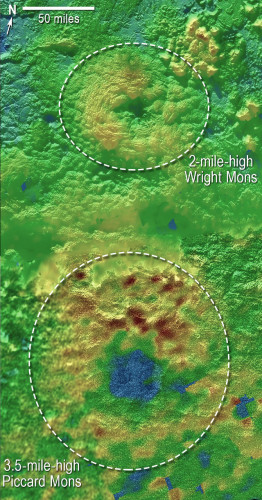
3-D topographic mapsWright Mons and Piccard Mons, the possible cryovolcanoes. The color depicts changes in elevation, blue indicating lower terrain and brown showing higher elevation. Green terrains are at intermediate heights (Image NASA/JHUAPL/SwRI)

NASA’s New Horizons mission team is presenting the latest findings on the dwarf planet Pluto at the 47th Annual Meeting of the American Astronomical Society’s Division for Planetary Sciences in National Harbor, Maryland. The data collected by the spacecraft during its July 14, 2015 flyby made it possible to identify possible cryovolcanoes. Data on small moons of Pluto are limited but suggest more and more that at least Cerberus and Hydra are the result of the merger of two or more asteroids.

Locations of 19 auroral detections (white circles) on Mars The data is superimposed on the magnetic field line structure where red indicates closed magnetic field lines, grading through yellow, green and blue to open field lines in purple (Image based on data from J-C. Gérard et al (2015))

Two articles, one published in “Journal of Geophysical Research: Space Physics” and one published in the journal “Icarus”, describe a research on ultraviolet auroras detected on Mars by ESA’s Mars Express space probe. Jean-Claude Gérard and Lauriane Soret of the University of Liege, Belgium, led a team of scientists who examined ten years of data that were analyzed to understand the mechanisms of creation of these auroras.