2015

Artistic representazion of a solar storm stripping gas from Mars atmosphere (Image NASA/GSFC)

Two magazines host a number of articles describing the results of a year of the mission of NASA’s MAVEN space probe, “Science” and “Geophysical Research Letters”. The conclusions about why Mars lost most of its atmosphere were also explained in a NASA press conference held yesterday. Simply put, it was solar wind, which could take away the atmosphere thanks to the absence of a protective magnetic field transforming a planet that was originally similar to Earth in the desolate red planet we know today.

The Super Strypi rocket on the launch pad on October 23, 2015 (Photo USAF)

A few hours ago the first test launch of the Super Strypi rocket in the mission referred to as ORS-4 was conducted but ended in failure. The rocket regularly blasted off from the U.S. Navy’s Pacific Missile Range Facility in Kauai, Hawaii but after about a minute lost control and after a few seconds broku up with the consequent destruction of the 13 satellites it was supposed to put in orbit.

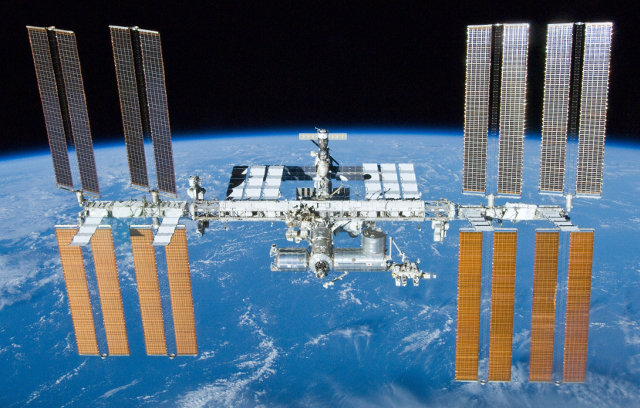
The International Space Station photographed by a space shuttle Atlantis crew member on May 23, 2010 (Photo NASA)

On November 2, 2000, the first three crew members reached the International Space Station to begin their work in what was then the new outpost of humanity. With that act, American astronaut Bill Shepherd and Russian cosmonauts Sergei Krikalev and Yuri Gidzenko established a continuous human presence there. Over the years, the Station has been expanded to take its current configuration developing wider and wider opportunities to do research that have brought and will bring various technological and scientific developments.

Diagram of coronal eruption. At the left the corona (feature in purplish colors) gathers inward, becoming brighter, before shooting away from the black hole (middle and right) (Image NASA/JPL-Caltech)

An article published in the journal “Monthly Notices of the Royal Astronomical Society” describes the detailed observation of a huge X-ray eruption by a supermassive black hole known as Markarian 335 or Mrk 335. The Swift and NuSTAR space telescopes were used to examine this phenomenon of gigantic proportions concluding that it originated from a coronal ejection.

Artistic representation of the Voyager 1 space probe in deep space (Image NASA/JPL-Caltech)

An article published in “Astrophysical Journal Letters” describes a new analysis of the data collected by NASA’s Voyager 1 space probe to understand why certain detections were abnormal. Voyager 1 entered interstellar space in 2012 but the unclear data raised discussions. After about a year, NASA confirmed the event but some unexpected characteristics of the solar system borders required further studies.