

At the American Astronomical Society’s meeting in Kissimmee, Florida, astronomers presented the results of research that aims to understand how come the multiple systems of stars and planets from the material on the disks of dust around new stars. The radio telescope Karl G. Jansky Very Large Array (VLA) was used to study almost one hundred newborn stars in the Perseus molecular cloud to try to answer these questions.
The Perseus molecular cloud is a huge cloud of gas and dust about 750 light years from Earth. Exactly because it’s relatively close and in the last few million years in some of its regions there was the formation of various stars, it’s a perfect subject for the study of their early life. Some teams of researchers examined the images gathered by the VLA Nascent Disk and Multiplicity (VANDAM) Survey between 2013 and 2015.
This new survey provided observation better than the previous ones in terms of quantity and quality. The sample of young stars observed was greater than previous studies and revealed objects with dimmer light than could be previously studied and in more detail. The disks of materials that surround newborn stars are obscured by the cloud in which they are forming but this new survey carried out with VLA can show them providing critical details on the mechanisms of their formation.
According to one of the teams that studied these data, there may be two different mechanisms behind the formation of multiple star systems. The difference may be made by the distance between the stars because in some systems they’re far from each other about 75 astronomical units (that is, 75 times the distance between the Earth and the Sun) whereas in other systems their distance is about 3,000 astronomical units.
All stars are formed from clouds of dust and gas and the formation of multiple systems is more common than single stars. According to the researchers, if the stars are distant from each other they’re formed through the turbulent fragmentation of the cloud. Instead, in the case of nearby stars there is a fragmentation within the disk of material orbiting the original protostar.
The researchers also found that older systems have less fewer companions far away from each other than younger systems. In their opinion, that suggests that some young stars that are distant from each other during their formation are not gravitationally bound. The consequence is that over time they move further away.
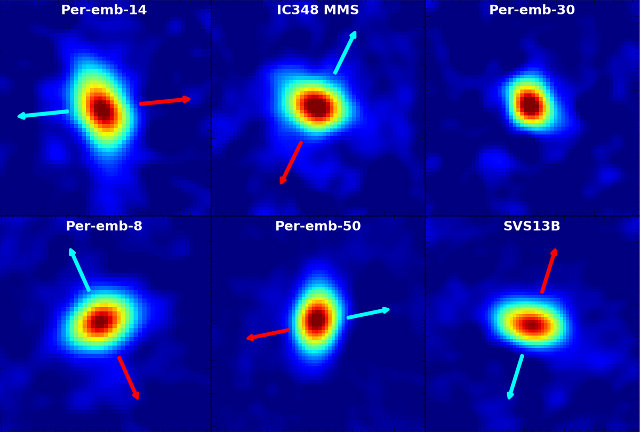
Another team that analyzed the data collected with VLA found that the disks of dust and gas surrounding some protostars are larger than predicted by some theoretical models. These disks are crucial to the formation of planets, some binary companions and the possibility that young stars will attract additional materials.
A study published in December 2015 described the influence of the materials falling toward the protostar on its magnetic field. It becomes stronger close to the star and that could cause a slowdown in the disk rotation, limiting its size and its growth.
The Perseus molecular cloud contains an amount of material for about 10,000 solar masses and is one of the nearest regions in which stars with small and intermediate masses are forming. There are still discussions about the mechanisms of star formation and instruments such as the VLA radio telescope can help observe this cloud in the best way to answer all those questions.

Permalink