
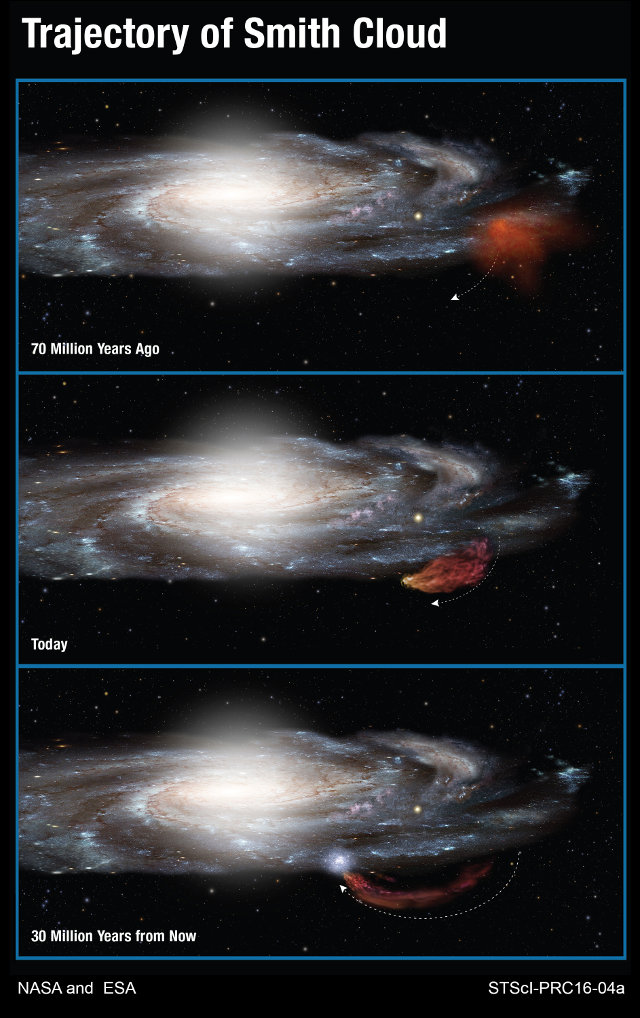
An article published in “The Astrophysical Journal Letters” describes a research about the so-called “Smith Cloud” (or “Smith’s Cloud”). It’s a giant cloud of hydrogen which is currently outside of the Milky Way but is heading towards our galaxy at about 1.1 million km/h (almost 700,000 mph). Observations made using the Hubble Space Telescope suggest that it was ejected from the Milky Way galaxy about 70 million years ago and now is coming back.
The Smith Cloud was discovered in 1963 thanks to the radio emissions coming from the hydrogen that forms it by Gail Bieger, who was then an astronomy student at the University of Leiden in the Netherlands. Since then it’s been the subject of several observations that allowed to estimate its length at around 11,000 light years and its width at around 2,500 light years for a mass of at least one million solar masses.
Over the decades, astronomers have theorized about the origin and nature of the Smith Cloud: was it a sort of failed galaxy without stars? Or was it an intergalactic cloud of gas that was heading towards the Milky Way? Right, because there was already this certainty and the speed at which it’s moving is really very high!
For decades the image of the Smith Cloud haven’t been detailed enough to understand its origin. In recent years, things have changed considerably and it was possible to start studying it in greater depth. Finally, the mysteries of the origin of the Smith Cloud could be solved by comparing its composition with that of the Milky Way.
The Hubble Space Telescope allowed to make observations of the Smith Cloud to capture the ultraviolet light emitted from the cores of three active galaxies billions of light years behind it. In this way, Hubble’s COS (Cosmic Origins Spectrograph) instrument measured how this light is filtered through the cloud.
Particular attention was placed on traces of sulfur in the Smith Cloud, which can absorb ultraviolet light. Sulfur is an element used to obtain indications on the quantity of elements heavier than hydrogen and helium in the cloud to compare it with that present in the Sun and in other stars in the Milky Way.
The result is that the amount of sulfur present in the Smith Cloud is very similar to that present in the Milky Way’s outer disk, a region even farther away from the galaxy core than then Sun. This means that this cloud was enriched by materials from the stars from that region but that could have happened only if it originated in the galaxy and was later ejected.
The Smith Cloud has a trajectory that will bring it back into the Milky Way in about 30 million years and probably the gas that makes it up will be compressed leading to the birth of new stars. There’s still the mystery of its birth and the cause of its ejection from the Milky Way. One hypothesis is connected to the passage of dark matter but it will take more research to understand more about it.
[ad name=”eBayUSUKNASA”]
