In recent months we go used to seeing the extraordinary photographs of the dwarf planet Pluto and its moons taken by NASA’s New Horizons space probe during its July 14, 2015 flyby but there are other instruments on board that were used to make various detecions. Like the photos, the data collected will keep on being sent for several more months. Those received so far by NASA have uncovered a presence of water ice greater than anticipated and allowed us to see the atmosphere of Pluto at infrareds.
The LEISA (Linear Etalon Imaging Spectral Array) instrument carried out an infrared scan of Pluto during the flyby, when the New Horizons spacecraft was about 108,000 kilometers (67,000 miles) away from the dwarf planet. Two scans performed 15 minutes apart were combined to obtain a map of the hemisphere visible for the probe. It includes various wave frequencies detectable by LEISA.
A first result was obtained by comparing the spectra acquired by LEISA with that of ice water, obtaining the map on the left in the image. The technique proved to be limited because the water ice spectrum is overshadowed by that of methane ice. For this reason, it shows the presence of water ice only where it’s abundant and where there’s little methane ice.
The scientists improved the map using a model that includes all the types of ice on Pluto. The limitation of this technique is given by the fact that it only allows to map the ice types included in the model but adding other measurements as long as they arrive from the New Horizons space probe it’s possible to improve the model. The result is the map on the right in the image.
In this map the ice water results much more common on the surface of Pluto than previously thought. However, there are still some areas where that type of ice seems to be absent or very limited such as in those informally called Sputnik Planum and Lowell Regio. However, it’s possible that the ice water bed is covered by other types of ice such as that of methane and carbon monoxide.
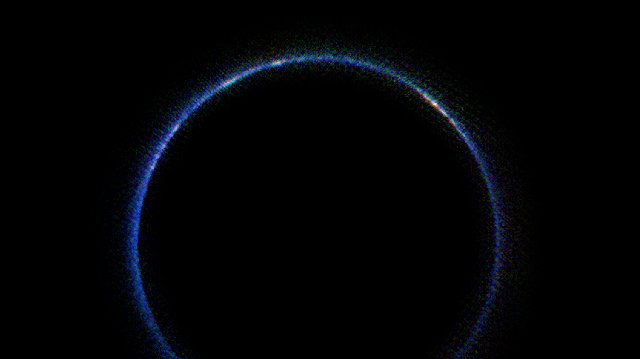
The LEISA instrument was also used to observe the atmosphere of Pluto at infrareds during the New Horizons space probe’s flyby. The picture shows the blue glow around the dwarf planet seen from a distance of about 180,000 kilometers (112,000 miles). It’s caused by what NASA called photochemical smog caused by the action of sunlight on methane and other molecules.
Molecules such as those of acetylene and ethylene are produced in the atmosphere and accumulate into small particles that may have a size less than one micrometer. Despite their really tiny size they have an effect on the light that strikes the atmosphere, generating the blue color. In some areas you can see a more whitish light where sunlight bounces off more reflective or smooth areas of Pluto’s surface.
NASA scientists are waiting for the New Horizons space probe to send more data collected by LEISA to continue these and other analyzes. Each new study allows a better understanding of Pluto with spectacular pictures and more information that also help to understand the history of the outer part of the solar system.