
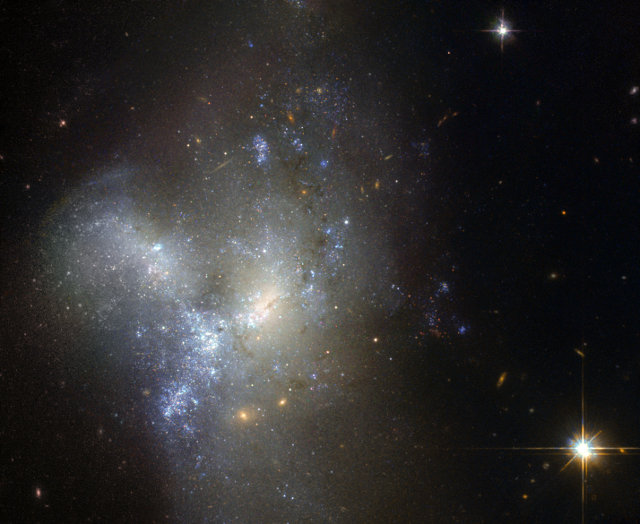
The Hubble Space Telescope photographed a really peculiar galaxy called NGC 1487. It was defined an event rather than a celestial object because it’s the result of a merger between two but perhaps even more galaxies that formed something very different. Astronomers are unable to say how many galaxies were involved in the phenomenon nor what they looked like. This merger probably caused the birth of many new giant stars.
NGC 1487, also known as ESO 249-31, VV 78 or LEDA 14117, is about 30 million light years away from Earth. It falls into the category of peculiar galaxies, which are those unusual in shape, size or composition. It’s a category that includes galaxies of many different types, from the irregular ones to ring galaxies. A typical case of peculiar galaxy origin is the interaction between galaxies and the merger is an interaction that goes to its extreme consequences.
According to one estimate, the galactic merger that created NGC 1487 took place about half a billion years ago but it’s difficult to make accurate assessments when it’s not even clear how many galaxies there were originally. According to one hypothesis, originally there was a small group of dwarf galaxies close to each other but eventually the force of gravity prevailed and all of them ended up merging with each other.
In the outer regions of NGC 1487 you can be seen yellow and red stars, old stars “inherited” from the original galaxies. However, there’s a significant presence of blue giants which very probably were born precisely because of the galactic merger. That’s because events of this type cause a gravitational shock and therefore the compression of the gas clouds present in the galaxies that are merging. The consequence is that local accumulations of gas occur that after some time lead to the birth of new stars.
The Hubble Space Telescope’s WFPC2 (Wide Field and Planetary Camera 2) captured several photos of NGC 1487 that were put together to create this image. Perhaps we’ll never know the exact origin of this galaxy but it reminds us that in the universe some events can have a truly huge scale.
[ad name=”AmazonDocumentary”]
