
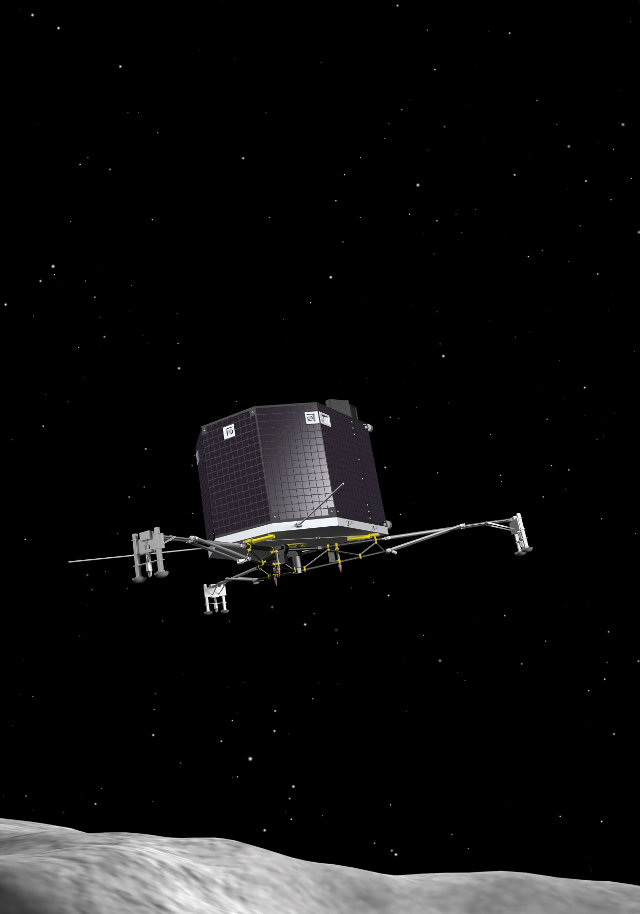
The hopes to be able to contact the lander Philae on the comet 67P/Churyumov-Gerasimenko’s surface have now faded and ESA is also pessimistic. DLS, the German space agency, runs the LCC (Lander Control Center) and in recent months tried to re-establish contact after Philae communicated for a while on several occasions but issued a statement declaring that it’s time to say goodbye to the lander.
The adventure of the Philae lander proved even more difficult than expected. For the first time a probe has landed on the surface of a comet but Philae bounced a number of times after its harpoons haven’t anchored it to the ground. After a brief period of activity it seemed entered into hibernation due to inability to recharge the batteries.
Instead, the comet 67P/Churyumov-Gerasimenko’s approach to the Sun allowed it to have enough energy to communicate with the Rosetta space probe, even if only sporadically. ESA took action to try to restore a permanent contact but after the last contact occurred on July 11, 2015, hopes have quickly started fading.
In early January 2016, the last attempts to send commands to the lander Philae were made. In particular, a command to make it move in the hope of shaking the dust off its solar panels was sent. Unfortunately even this effort produced no results and at that point ESA really started to lose hope.
Some hypotheses were proposed to explain the communication problems of a lander that was still working. According to the first hypothesis, the temperatures were too low and damaged some of Philae’s system. According to the second hypothesis Philae’s solar panels got covered by the dust that settled after the comet 67P/Churyumov-Gerasimenko passed perihelion in mid-August 2015. According to the third hypothesis Philae moved and its antennas oriented to a different direction so the Rosetta space probe could no longer intercept its signals.
The comet 67P/Churyumov-Gerasimenko is moving away from the Sun and this is both an advantage and a disadvantage. The Rosetta space probe can get closer and closer because the gas and dust emissions and consequently the dangers are falling. On the other hand, the hope that Philae can receive enough energy to communicate are now very little.
ESA is considering for Rosetta to make a flyby to be able at least to accurately locate the lander’s position. A good quality photograph would allow to better understand its situation as well and in particular its slope and its solar panels’ conditions but Rosetta’s safety is the priority.
At this point it’s almost certain that Philae is in hibernation and probably at least some of its systems got damaged by the cold. In the short period in which it communicated with the Rosetta space probe it sent many useful data and its experience will be useful for other missions, also on asteroids. The Philae mission didn’t go very well but still accomplished the first landing on a comet’s surface. Problems, even serious ones, unfortunately happen easily when you boldly go where no one has gone before.
[ad name=”eBayUSUKAstronomy”]
