
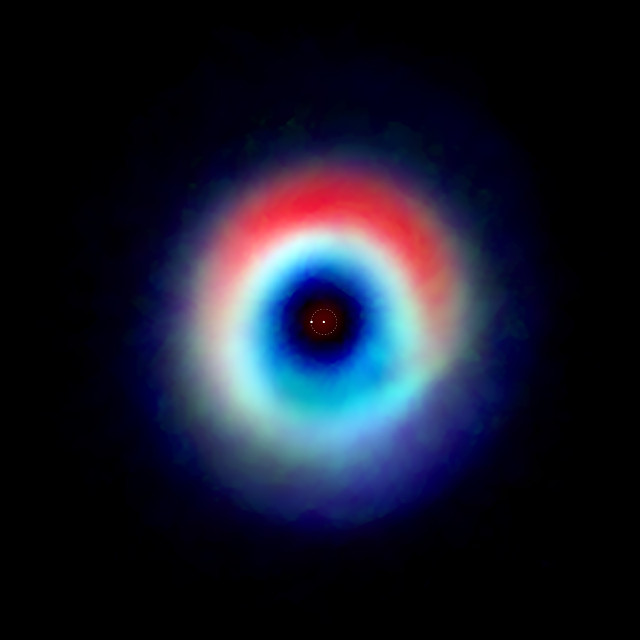
At the meeting of the AAAS (American Association for the Advancement of Science) just concluded in Washington, D.C. the latest results were presented about the observations of the HD 142527 star system carried out with the ALMA radio telescope. It’s been an object of study by astronomers for some time and is particularly interesting because it’s very young. This means that around the central star there’s a ring of gas and dust that is probably forming one or more planets but there’s also a second star. This type of study will help to understand the formation of planets in binary systems.
The HD 142527 system has already been observed also with the ALMA radio telescope, which a little over three years ago made it possible to discover interesting details on the structure of the disks of dust and gas surrounding the central star. The models describing planets formation are still incomplete so newborn systems like this are extraordinary opportunities to test them and acquire new knowledge to improve them.
The formation of planets in binary systems is only partially understood. In particular, the researchers are trying to understand how they can form and maintain stable orbits around two stars. Early models even suggested that this wasn’t possible and the combination of the two stars’ gravity would cause the planets to have eccentric orbits or even eject them from the system. The recent years discoveries show that stable orbits are possible for planets in such systems so they’re among the main objects of astronomical studies.
The ALMA radio telescope was officially inaugurated in March 2013 but was completed only after several months. This means that the most recent observations are much better than those from three years ago. In the case of the HD 142527 system that means that this recent study has uncovered new details on the materials surrounding the two stars.
The new high-resolution images allowed to analyze the composition of the ring around the two stars. It’s made up mostly of gases including carbon monoxide while the arc that covers nearly a third of the system consists of dust and ice.
The area shown in red in the image is the one in which the dust density reaches its highest levels. Where there are dense lumps of dust there’s no carbon monoxide, shown in blue and green instead. One hypothesis is that the gas molecules may freeze in the dust because of the very low temperatures and get stuck to the dust.
This could be an important factor in planet formation because these lumps are more like snowballs than stones that and it’s easier that they merge following a collision. The ice could act as a sort of glue allowing a snowball to become more and more massive until gravity becomes strong enough to make the object grow with rocky materials as well.
Radio telescopes can analyze these newborn systems much better than other telescopes because radio waves pass through gas and dust, which instead block visible light and many other electromagnetic wave frequencies. It’s for this reason that instruments such as ALMA are crucial for this type of studies. The observations of the HD 142527 system and other newborn systems will continue and certainly we’ll have more surprises.

Permalink