February 2016

Panoramic view of the galaxies in the local supercluster (Image IPAC/Caltech, by Thomas Jarrett)

An article published in the journal “Astronomical Journal” describes a research that offers at least a partial explanation for the cosmic phenomenon called the Great Attractor. An international team used the 64-meter Parkes radio telescope in Australia to make observations through the galactic Zone of Avoidance, an area of space obscured by the Milky Way itself with its stars and dust clouds. In this way the researchers found hundreds of previously unknown galaxies, ea progress in the gravitational anomaly’s explanation.

The gravitational waves detected by LIGO (Image courtesy LIGO)

In Washington, D.C. a press conference was held to announce that the LIGO experiment found the gravitational waves predicted by Albert Einstein’s theory of general relativity. Two blacks holes about 1.3 billion light years from Earth merged as a result of a collision emitting those waves.

LIGO (Laser Interferometer Gravitational-Wave Observatory) is an instrument designed specifically to detect gravitational waves. It was created in a collaboration between Caltech (California Institute of Technology) and MIT (Massachusetts Institute of Technology) with funding from the American NFS (National Science Foundation).

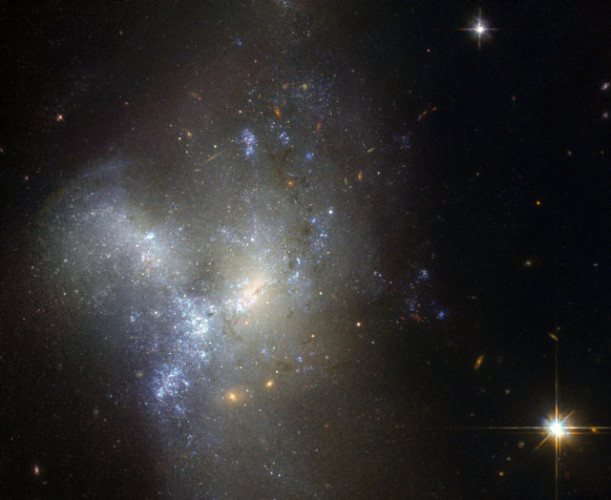
The galaxy NGC 1487 photographed by the Hubble Space Telescope (Image ESA/Hubble & NASA / Judy Schmidt)

The Hubble Space Telescope photographed a really peculiar galaxy called NGC 1487. It was defined an event rather than a celestial object because it’s the result of a merger between two but perhaps even more galaxies that formed something very different. Astronomers are unable to say how many galaxies were involved in the phenomenon nor what they looked like. This merger probably caused the birth of many new giant stars.

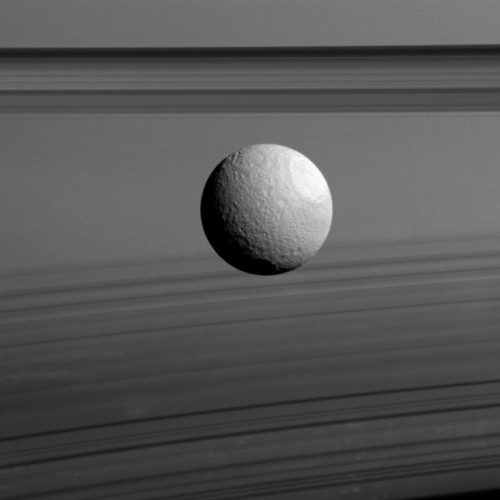
Saturn's moon Tethys with the planet's rings in the background (Image NASA/JPL-Caltech/Space Science Institute)

NASA has published a photograph taken by the Cassini space probe that frames Tethys, one of Saturn’s moons, in front of the planet’s rings. They have such a relative position Tethys seems to float between two sets of rings but it’s just an optical effect. The result is a particularly striking image even by the standards of a mission that has been offering stunning portraits of the planet Saturn, its rings and its moons.

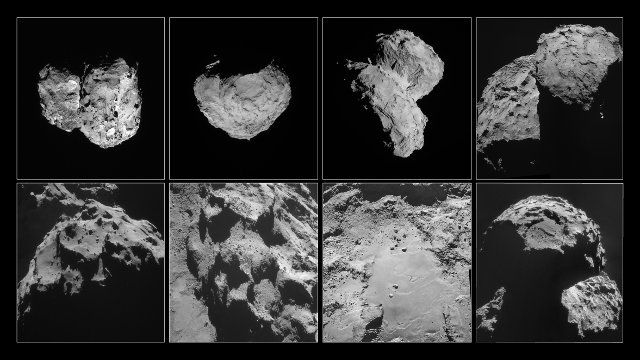
Pictures of the comet 67P/Churyumov-Gerasimenko taken by the Rosetta space probe between August and November 2014 (Image ESA/Rosetta/NavCam – CC BY-SA IGO 3.0)

An article published in the journal “Nature” describes a research about the internal structure of the comet 67P/Churyumov-Gerasimenko. A team of scientists, led by Martin Pätzold, from Rheinische Institut für Umweltforschung an der Universität zu Köln, Germany, analyzed data collected by ESA’s Rosetta space probe to provide some answers to the astronomers’ questions. According to their findings, the comet’s internal structure is quite homogeneous and contains no large caves. The total mass was estimated at nearly 10 billion tons.