
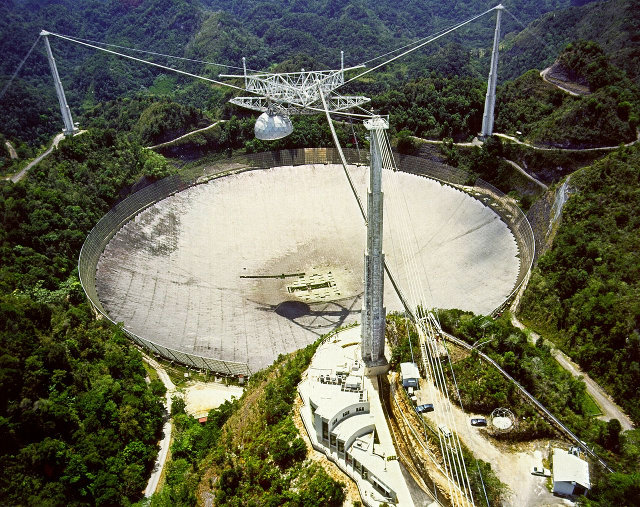
An article published in the journal “Nature” describes a study following the discovery of repeating fast radio bursts. For the first time, this kind of phenomenon repeated and a team of researchers led by Laura Spitler of the Max Planck Institute for Radio Astronomy in Bonn, Germany, was able to identify a sequence of signals coming from the same source using the Arecibo radio telescope.
Fast radio bursts are still mysterious phenomena but recently there was some progress in their investigation. Again the journal “Nature” recently featured an article on identifying the origin of a fast radio burst. Now the discovery of repeating signals is very important because it helps scientists to get a better idea of their possible causes.
For years, thinking they were single events, many scientists thought that fast radio bursts originated from catastrophic events such as supernovae or the further collapse of a neutron star that becomes a black hole. The fact that these signals can repeat indicates that at least part of them have different origins.
The duration of fast radio bursts is a few milliseconds and this made their recording and thus the investigations into their nature complex. The repeating signal studied in this research was picked up by the Arecibo radio telescope, the biggest single-aperture of the world with its 305-meter antenna.
In November 2015 Paul Scholz, a PhD student at McGill University, found in the archive of the data from the Arecibo Observatory 10 fast radio bursts consistent with one detected in 2012 and called FRB121102 (FRB means Fast Burst Radio). Scholz immediately understood it was an important discovery and from there the study began, also to try to understand the possible source of those signals.
One possibility is that a neutron star emits fast radio bursts. Laura Spitler pointed out that the 10 signals studied by her team have brightness and spectrum different from those of other radio bursts. This means that they could constitute a new subclass of these signals.
In short, this research provided some answers but added new questions. Victoria Kaspi, director of the McGill Space Institute and part of the team that conducted the study, stated that she hopes the CHIME (Canadian Hydrogen Intensity Mapping Experiment) radio telescope that is scheduled to begin its operations in the course of 2016 may help research into fast radio bursts. Thanks to its innovative design CHIME should be able to detect these signals every day, a significant step forward in the research on them.

Permalink