
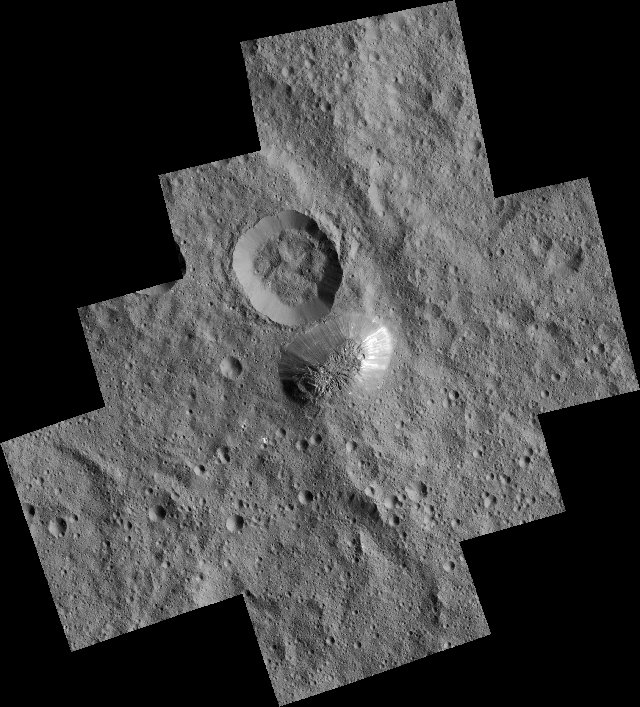
Between March 6 and 7, 2015, depending on your time zone on Earth, NASA’s Dawn space probe entered the orbit of the dwarf planet Ceres. In December 2015 it went down to a lower altitude to conduct a mapping with the best definition and in February 2016 its orbital path led it into a position where it could take excellent pictures of Ahuna Mons, as they called the mountain that used to look like a pyramid and is one of the most curious geological features on Ceres.
Ahuna Mons was discovered in February 2015 but it took a long time for the Dawn space probe to came near enough to make useful observations for a geological study. It is probably the result of some cryovolcanic activities but is isolated, not part of a mountain range or at least a small group of similar formations.
Until a few months ago, Ahuna Mons appeared to have the shape of a pyramid and only now that the Dawn space probe photographed it from a relatively close position it was possible to understand that its shape is more like that of a dome with smooth, steep walls. Instead, it was confirmed that there are bright materials in large quantity on some of its walls. Those could be the same salts that seems to form the famous white spots.
Ahuna Mons is an interesting mystery because of its features. Its origin as a result of a cryovolcanic activity is a hypothesis but Chris Russell, Dawn mission’s principal investigator, admitted that he and his colleagues still don’t have a satisfactory model to explain its formation.
The information that NASA has been gathering studying Pluto with its New Horizons mission have already shown that even a dwarf planet may have a geologic activity. Ceres is smaller than Pluto but something important must have happened on its surface to generate a mountain as big as Ahuna Mons.
The Dawn space probe will continue its mapping operations from its final orbit, the lowest at an altitude of 385 km (240 miles) above the surface of Ceres, at least until June 2016, when it will end its primary mission. This means that scientists will receive more data for at least some months and their analyzes will continue for years to try to solve the mysteries of Ceres.

Permalink