
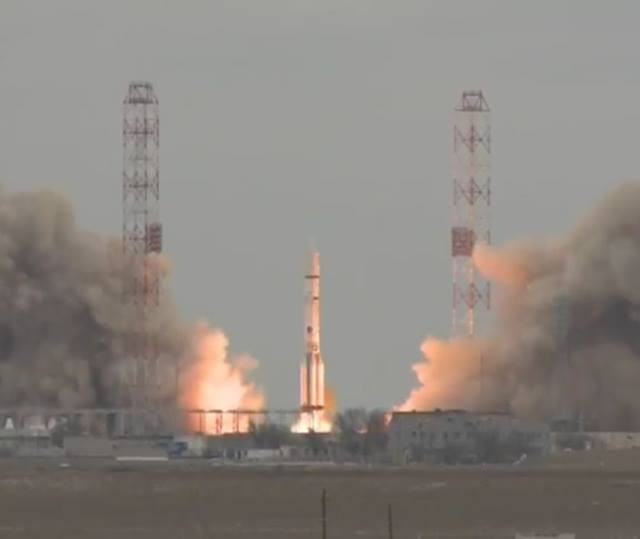
ESA and Roscosmos’ TGO spacecraft and Schiaparelli lander launched atop a Proton-M rocket from the Baikonur Cosmodrome in Kazakhstan. After about 10 minutes, the Breeze M upper stage separated and began the ten-and-a-half hours of maneuvers that will take them out of the Earth’s orbit and en route to the planet Mars.
The ExoMars program was initially created as a collaboration between ESA and NASA but due to budget problems, the American agency had to withdraw from the project. At that point, the Russian space agency Roscosmos took over and provided the rockets for launches and some instruments. The spacecraft, the lander, and other instruments were developed by the various ESA nations with a strong Italian contribution.
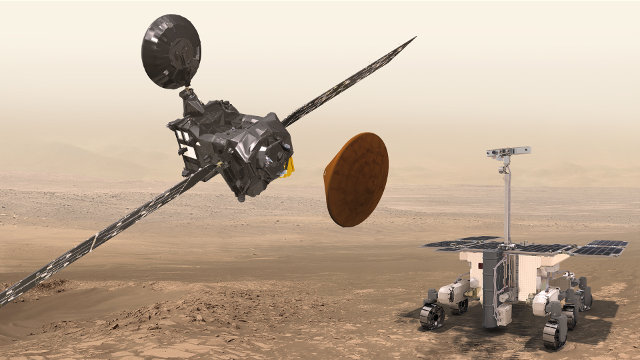
The ExoMars program consists of two missions that aim to explore in different ways the planet Mars to discover if life forms ever existed. The one launched today is the first mission, composed of the Trace Gas Orbiter (TGO) spacecraft, which has the aim of studying Mars from its orbit, and the lander Schiaparelli, which has the aim to test some technologies that will be used for subsequent missions beginning with the second ExoMars, which includes a rover and a scientific surface platform.
Previous surveys already showed that on Mars there’s a small amount of methane, the problem is to establish its origin. On Earth, methane is created by biological processes but there are also non-biological chemical processes that can produce it. Some geological processes such as the oxidation of certain metals can lead to the release of methane and are considered some of the hypotheses to explain the source of the methane on the red planet.
The TGO is equipped with a set of very sophisticated instruments to monitor the presence of methane but also other gases such as water vapor, hydrogen oxides and compounds such as acetylene more accurately compared to the space probes sent in the past. The measurements of seasonal variations will improve the models of the Martian atmosphere, a further help to better understand its evolution.
The Schiaparelli lander will test the European Mars landing technologies with a heat shield that will protect it from friction, a parachute and a propulsion system to slow its descent. A structure specially produced will aim to cushion its impact with the Martian soil.
The area chosen for the landing of the lander Schiaparelli is called Meridiani Planum. Although its main mission is to test the systems that will be used to land the rover which will make up the second mission of the ExoMars program, Schiaparelli has some instruments that will detect data during its descent into Mars’ atmosphere and after its landing. However, this phase will last only until its battery power is depleted.
The rover is supposed to be launched in the next window useful for launches to Mars, more or less in May 2018. However, there are doubts that it can be ready, and if not we’ll have to wait about 26 more months, probably summer 2020. Meanwhile, if all goes well, the TGO and Schiaparelli will reach Mars in October 2016.

Permalink
Permalink