
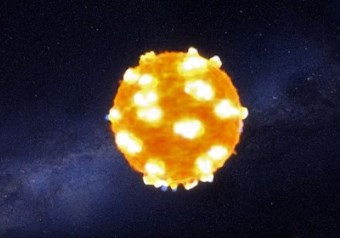
An article accepted for publication in the journal “Astrophysical Journal” describes the shock wave generated by a supernova observation, captured for the first time at visible light due to strong flash that generates when erupts from the star’s surface. An international team directed by astrophysicist Peter Garnavich of the University of Notre Dame in Indiana analyzed data collected by the Kepler space telescope about 50 trillion stars to make this discovery.
During its original mission, the Kepler space telescope was able to continuouly scan huge portions of space. Its work was mainly focused on planet hunting but the observations it made may be useful for other types of research as well. In the case of Peter Garnavich research team it was about traces of supernovae.
In 2011 two red supergiant stars exploded while they were observed by the Kepler space telescope. The first, called KSN 2011a, had a size nearly 300 times that of the Sun and is located about 700 million light years from Earth. The second, called KSN 2011d, was about 500 times larger than the Sun and is located about 1.2 billion light years from Earth.
The period in which the shock wave of a supernova erupts from its surface, called in jargon “shock breakout”, lasts only 20 minutes so in order to record this phenomenon you need to have a telescope focused on the star. This result was achieved thanks to the Kepler space telescope and its continuous monitoring of the sky.
This type of supernova is classified as type II and happens when a star runs out of nuclear fuel. At that point, a gravitational collapse that eventually leads to the explosion starts. The supernovae identified by the Kepler space telescope showed characteristics that have a good match with the type II mathematical models confirming the existing theories.
However, these supernovae also showed some unexpected features. In particular, the less massive star didn’t show the breakout shock. According to the scientists, this might be due to the fact that it was surrounded by gas that may have masked the shock wave after it reached the surface. It will take more research to gain a good understanding of the issue.
In recent decades, astronomers were able to watch several supernovae but this time the stars got caught in the very first moments of their explosion providing new information on this phenomenon. Understanding these stellar mechanisms is not only a scientific curiosity because in supernovae heavy elements are produced, including those found in our bodies.
Peter Garnavich is part of the research team called Kepler Extragalactic Survey (KEGS), which almost finished analyzing the data of the Kepler space telescope’s original mission. After the failure of its reaction wheels, it was reactivated thanks to an ingenious solution and the KEGS team will examine the new data to find more supernovae in even more distant galaxies.
