

At the 47th Lunar and Planetary Science Conference held last week in The Woodlands, Texas, the latest news about the mountains of Titan, the largest of Saturn’s moons, were presented. NASA also presented the progress made in creating maps of this moon, a task that has to face a number of problems. All these works are based on data collected by the Cassini space probe.
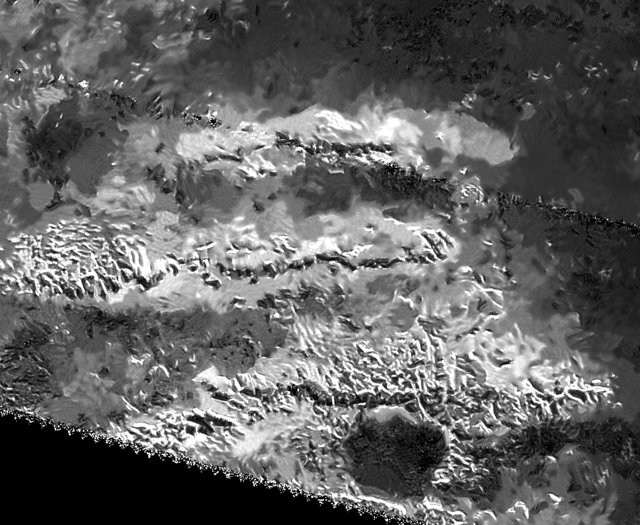
Since 2004 Titan has been one of the objectives of Cassini’s observations, which allowed to get to know among other things the mountain ranges existing on this satellite. In the mountainous ridge called Mithrim Montes there’s also the highest peak on Titan with its 3,337 meters (10,948 fee) of height. Other mountains may reach 3,000 meters (almost 10,000 feet), but probably that’s the highest of all.
To find the highest mountains it was necessary to use images and other data from the Cassini space probe’s radar. That’s because Titan has an atmosphere which also contains a kind of smog which complicates direct observations. This is one of the reasons why the probe is equipped with instruments that can make detections even through it to observe the details of the surface.
Many Titan flybys made by the Cassini space probe, on average once a month. In these occasions the VIMS spectrometer was also used, which allowed to obtain a remarkable series of observations which however occurred in different conditions of light and visibility. In fact, they have been conducted during different Titan seasons and at different angles of sunlight.
The consequence is that the spectrometric images are affected by the different effects of light scattering and absorption in Titan’s atmosphere. These effects may also influence the brightness of different areas of the surface. The work necessary to eliminate these effects and achieve homogeneous maps isn’t simple and the researchers are working on it.
The image of Titan with Sinlap crater, approximately 80 kilometers (about 50 miles) wide, in the pane, shows the broad wavelengths range of the VIMS spectrometer. This series was obtained by using different wavelengths and colors and is useful to detect differences in the nature of the materials this satellite’s surface. Titan is one of the most intriguing celestial bodies in the solar system so the Cassini space probe will keep on studying it until the end of its mission.

Permalink
Permalink