
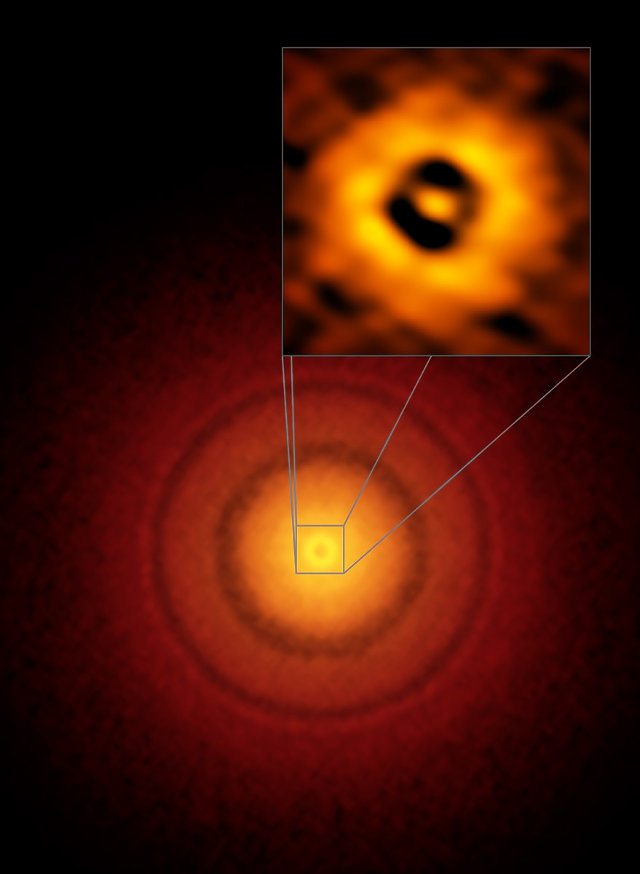
An article published in “Astrophysical Journal Letters” describes a research on a forming protoplanet in the TW Hydrae star system. By using the ALMA radio telescope, a team led by Sean Andrews of the Harvard-Smithsonian Center for Astrophysics in Cambridge, Massachusetts, obtained the best image of a protoplanetary disk produced so far.
The star TW Hydrae is a bit smaller than the Sun, is 175 light years away from the Earth, and has an estimated age of only about 10 million years. Its relatively small distance and its very young age make it a very interesting target from a scientific point of view. The orientation of the protoplanetary disc is favorable because it shows its “face” to the Earth allowing excellent observations.
Previously, the TW Hydrae system was observed using both optical and radio telescopes and they already spotted the protoplanetary disc with structures that suggested that there were planets in their formation stage. For this reason, it’s already been studied several times and in the last decade some researchers thought they had found a gas giant planet or even a brown dwarf but further observations led to the conclusion that the planet didn’t exist.
The experience accumulated in recent years of studies of other solar systems, sometimes even very young such as that of HL Tauri, along with more sophisticated instruments made it possible to improve the results. The ALMA (Atacama Large Millimeter / submillimeter Array) radio telescope, inaugurated in March 2013, was able to show the TW Hydrae system in details never seen before.
Thanks to ALMA, it was possible to see several concentric rings made of dust and dark interruptions with forms that indicate the probable formation of various planets. The orbit of one of them is similar to that of Earth and thinking about the fact that the star has a mass similar to that of the Sun it’s possible that the planet being born can become potentially habitable.
For this observation, ALMA was used in the configuration called long-baseline, with its antennae at their maximum separation, up to 15 kilometers apart. This allows the maximum detail resolution to detect the radio emission from millimeter-sized dust particles.
Other rings are much more distant from their star, in orbits similar to those of Uranus and Pluto. Again, it’s likely that the disc particles started coalescing to form new planets. At the moment, however, it’s impossible to tell their characteristics but they’re certainly interesting even if they’re too far from their star to become similar to the Earth.
Young systems such as TW Hydrae offer extraordinary windows into the ancient past of our solar system. In this case, there’s even a planet in formation in an orbit similar to that of the Earth which makes it even more outstanding. For these reasons, this type of research will continue to discover all the secrets of the formation of solar systems and planets like Earth.

Permalink