
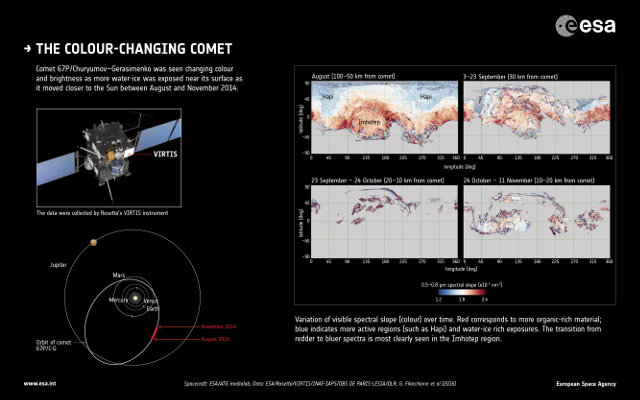
An article published in the journal “Icarus” describes the change in colors and brightness found on the surface of the comet 67P/Churyumov-Gerasimenko by ESA’s Rosetta space probe. These are the first findings of a study and concern the months immediately following Rosetta’s arrival in the comet’s orbit, in August 2014.
From that time until November 2014, the Rosetta space probe maintained a distance between 100 and 10 km away from the nucleus of the comet 67P/Churyumov-Gerasimenko and those were the months when it was approaching the Sun, from a distance of 542 million to 438 million kilometers (from 337 to 272 million miles). The consequence is that in that period the surface was warming up and various materials sublimated causing constant changes.
The Rosetta space probe’s VIRTIS (Visible and Infrared Thermal Imaging Spectrometer) instrument has been monitoring the changes of light reflected from the surface of the comet 67P/Churyumov-Gerasimenko in a wide range of electromagnetic frequencies of both visible and infrared light to detect changes in the composition of its outermost layer.
Initially, the comet 67P/Churyumov-Gerasimenko was surprisingly dark considering the amount of water ice it contains. This was due to the fact that most of its surface was covered by a layer of tendentially dark dust composed of a mixture of minerals but also of organic compounds.
With the approach to the Sun, the activity on the surface of the comet 67P/Churyumov-Gerasimenko has become more and more intense with increasing sublimation of various materials that formed its coma and tail. This determined also an ejection of the dust that covered its surface, leaving the existing ice under it increasingly exposed and for this reason the comet’s nucleus has become brighter and brighter.
This study covers only the data for the first months of the Rosetta mission but will go on analyzing the data of the next period. The researchers still have many months of data to examin to understand the mechanisms of activity of the comet 67P/Churyumov-Gerasimenko in the period when it was closest to the Sun. The research will end with the current stage where it’s moving away from the Sun and there’s a decline of activity on the comet instead.
