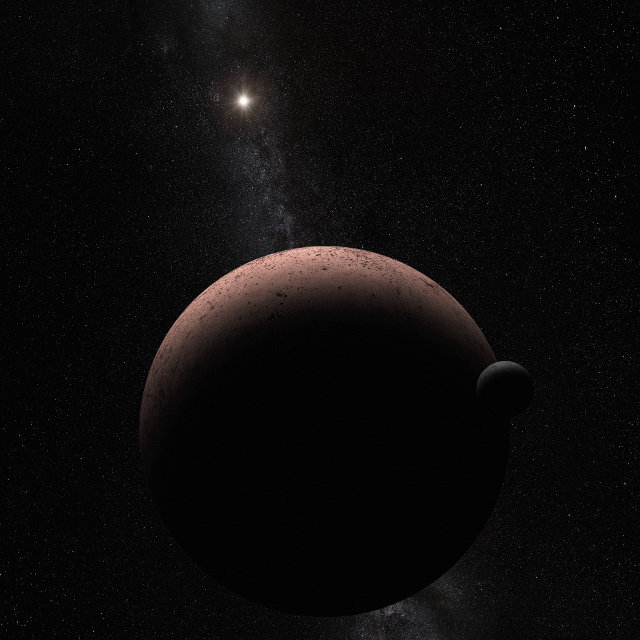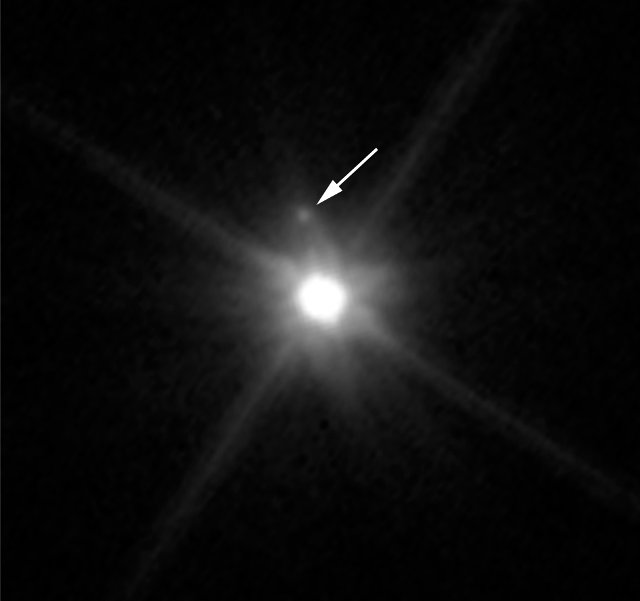
The Hubble Space Telescope has identified a moon of the dwarf planet Makemake. For the moment it was simply designated S/2015 (136472) and nicknamed MK2 and it’s a small moon with an estimated diameter of about 160 kilometers (about 100 miles). The discovery came from observations made in April 2015 using the Hubble’s Wide Field Camera 3 instrument.
The dwarf planet Makemake is also a recent discovery since it was identified in 2005. In 2008, the IAU (International Astronomical Union) officially recognized it as a dwarf planet. Its name derives from that of a deity from the mythology of the poeple of Easter Island (or Rapa Nui). It has the catalog number 136472 and that’s why the same number is also part of its moon’s designation.
Makemake’s distance from the Sun, much higher than Pluto’s, is just one of the reasons why it was so difficult to detect it. This dwarf planet also has a high orbital inclination, which means that its orbit has an angle that takes him too far from the ecliptic plane, where research are conducted to find new celestial bodies and to observe the ones already known.
With an average diameter of just over 1,400 km (about 870 miles), Makemake is smaller than Pluto but is brighter so now that is known we can keep an eye on it. In the past years, the Hubble Space Telescope uncovered Pluto’s smaller moons, now the same observation techniques uncovered MK2. In the past a number of astronomers tried to see if Makemake had any moons but with no luck.
The MK2 moon was located at a distance of about 21,000 kilometers (13,000 miles) from Makemake. According to preliminary estimates, its orbit is circular and a rotation around the dwarf planet takes at least 12 days. Those are still rough estimations and further observations will be required to make them more precise so some of them may turn out wrong.
When Charon, the largest of Pluto’s satellites, was discovered, astronomers used it to make more precise calculations of the dwarf planet’s characteristics. MK2 will help to make similar calculations about Makemake and this will allow to better estimate its mass, its density and its composition. New observations to determine with certainty the orbit of MK2 can also allow to understand whether it’s the product of the collision of the dwarf planet with another Kuiper Belt Object or a captured asteroid.
The existence of MK2 may solve a mystery about Makemake. Some observations of this dwarf planet made in the past showed a variation of its brightness but it was never seen again. It’s possible that it was its moon passing in front of Makemake as it seems much darker but the instruments used couldn’t take the two bodies apart.
The discovery of a moon of a dwarf planet so far away is a further step in the astronomical investigations of celestial bodies in the Kuiper Belt. It’s an outer area of the solar system we still have a limited knowledge about, so much that even the presence of an existing planet out there is theorized based on indirect clues only. Slowly, astronomers are discovering the secrets of that frontier.