
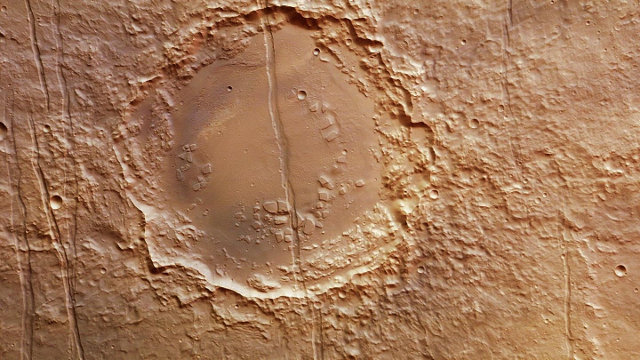
The German space agency DLR published photos of a curious crater marked by a deep rift that splits it in two in the area of Mars called Memnonia Fossae. These are photos taken by the High Resolution Stereo Camera (HRSC), one of the instruments of ESA’s Mars Express space probe.
The Latin word fossa – plural fossae – is used to describe a long, narrow depression on Mars. These geological features form when the Martian crust stretches until it finally breaks, for example due to the weight of a nearby volcano. There’s evidence of depressions also associated with dikes of magma that from the underground break the rocks and melt the ice.
The fault chain called Memnonia Fossae is located to the west of the volcanic region of Tharsis, whose bulging is considered its origin, and north of Sirenum Fossae, another similar formation. These geological features are about 1,600 kilometers (about 1,000 miles) long going from east to west and were called “Rift of Memnonia” after a complex of temples of the ancient Egyptian city of Thebes.
The Tharsis region is like a giant bowl the size of Europe that has a bulge of four or five kilometers (2.5 to 3.1 miles) upwards. This is the area that houses some of the largest volcanoes in the solar system including the gigantic Olympus Mons. There are still discussions about the exact origins of that bulging but probably large amounts of magma fed by the Martian mantle over billions of years exerted pressure on the crust from below.
Various layers of volcanic rock were added in the course of time causing a continuous increase of the pressure. On the other hand, the magma bubbles that came up from the Martian mantle generated pressure from below. The various stresses ended up generating a series of tectonic rifts, faults and cracks in the Tharsis region.
In the area called Memnonia Fossae probably water used to flow and it was a source for the complex called Mangala Valles, another part of the Tharsis region. More than 3 billion years ago it was very active volcanic area and the stress generated on the Martian crust created tectonic horst and graben.
In that area there’s this ancient impact crater with a heavily eroded rim and a diameter of about 52 kilometers (a little more than 32 miles). This unnamed crater is intersected by a graben about a kilometer and a half (almost a mile) wide. It’s one of many evidences of geological activity in the Tharsis region that show how Mars, when it was young, was alive and in many ways similar to Earth.

Permalink