
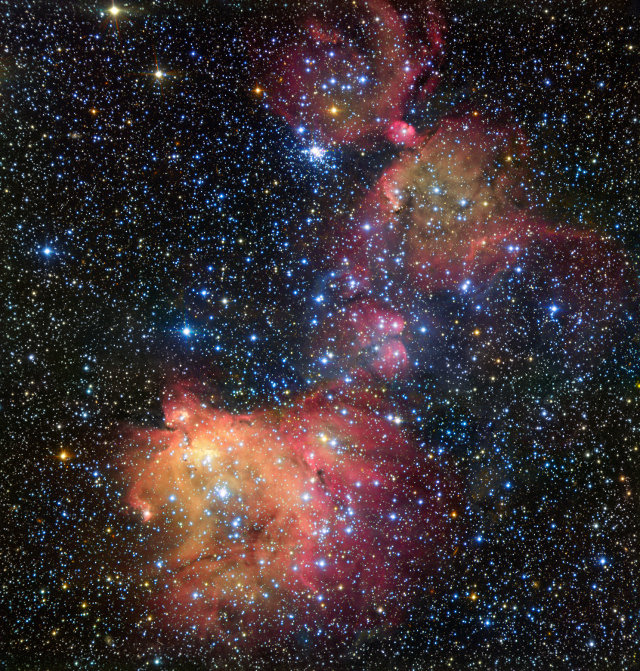
ESO released new photos of the nebula LHA 120-N55 – usually called simply N55 – taken with the VLT (Very Large Telescope). It’s an emission nebula located inside a so-called superbubble called CML 4 and has a halo that in the images has various colors like a cloak adorning recently formed stars and consists of gas remained after most of it was absorbed by those stars.
The N55 nebula is about 163,000 years light from the Earth, in the Large Magellanic Cloud, one of the Milky Way’s satellite galaxies. Superbubbles form due to multiple supernovas that emit shock waves and the solar wind from massive stars such as the big stars of N55. These violent astronomical phenomena sweep away most of the gas and dust creating bubble-shaped cavities that can be hundreds of light years across.
In the case of N55 a part of gas and dust that formed the nebula remained, isolated within the superbubble. A group of blue-white stars called LH 72 was born in the course of the hundreds of millions of years following the event that blew up the superbubble LMC 4. The stars of LH 72 are the second generation and the space around N55 was emptied by the first generation.
The presence of large stars generates the colors of the nebula because their intense light causes the ionization of the hydrogen atoms making them shine with a pinkish color at visible light. It’s a fingerprint that reveales the presence of young stars so astronomers can recognize it in any galaxy they’re watching.
The situation of N55 could remain stable for millions of years but when the stars of the LH 72 group start exploding their shockwaves will trigger another cycle in the superbubble LMC 4. This means that a new bubble may form within the superbubble and especially the gas will be compressed ending up forming new stars.
In that large area there’s still plenty of gas so it at least another generation of stars can form. This means that the transformation of superbubbles, bubbles and nebulae could, together with the stars that will be born and die, make that area spectacular for many millions of years.
These photos were taken using the FORS2 (FOcal Reducer and low dispersion Spectrograph) instruments mounted on VLT in ESO Cosmic Gems program that has the purpose of education and to arouse the public’s interest. The choice of the N55 nebula was definitely a success!
