May 2016

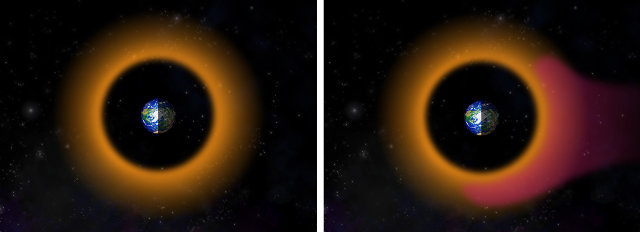
The ring current during quiet time (left) and during a geomagnetic storm (right) (Image Johns Hopkins APL)

An article published in the journal “Geophysical Research Letters” describes a research on the behavior of the ring of particles that surrounds the Earth. Using the measurements taken by the RBSPICE instrument aboard one of NASA’s Van Allen space probes it was possible to establish that high-energy protons in the ring current behave completely different from low-energy protons. It’s a step forward in the understanding of the Earth’s magnetosphere and therefore of the effects it may have on satellites and even the Earth’s surface.

The area that includes Chryse Planitia, Acidalia Planitia and Arabia Terra (a,c) with the close-up of a promontory (c) (Image J. Alexis Palmero Rodriguez)

An article published in the journal “Nature” presents a study that describes two possible mega-tsunamis that shook the surface of the planet Mars more than three billion years ago. According to a team led by J. Alexis Palmero Rodriguez of the Planetary Science Institute two meteorites hit Mars a few million years from each other but with similar effects. Perhaps at that time there was an ocean of liquid water and the impacts raised waves up to 120 meters (almost 400 fett) which engulfed large areas of the mainland.

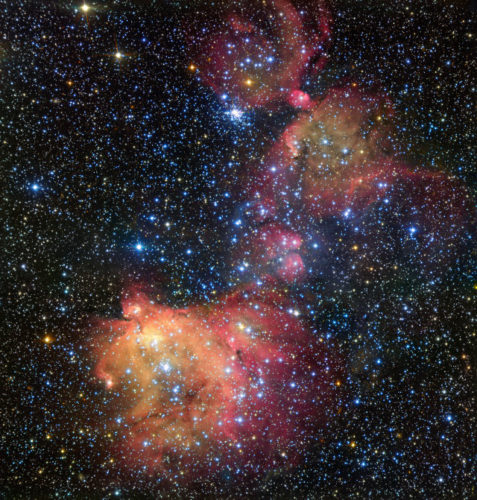
The LHA 120-N55 nebula photographed by the VLT (Photo ESO)

ESO released new photos of the nebula LHA 120-N55 – usually called simply N55 – taken with the VLT (Very Large Telescope). It’s an emission nebula located inside a so-called superbubble called CML 4 and has a halo that in the images has various colors like a cloak adorning recently formed stars and consists of gas remained after most of it was absorbed by those stars.

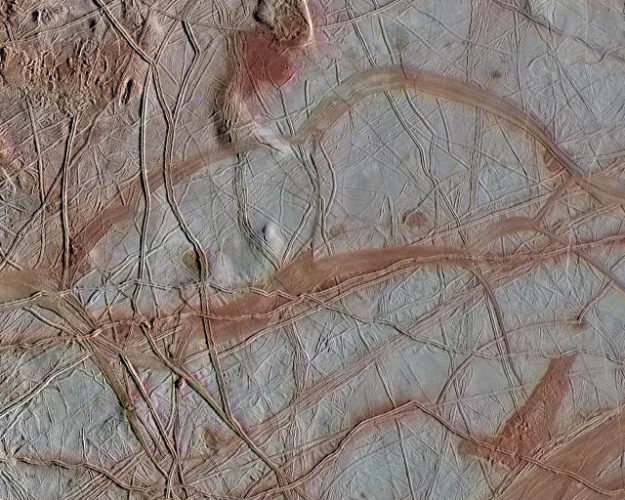
Europa's surface with its icy crust full of fractures (Photo NASA/JPL-Caltech/SETI Institute)

An article published in the journal “Geophysical Research Letters” describes a research on chemical characteristics existing in the underground ocean of Europa, one of the planet Jupiter’s big moons. A team of scientists at NASA’s Jet Propulsion Laboratory team (JPL) compared the potential to produce hydrogen and oxygen with that of the Earth, concluding that they’re comparable.

Image of the Tycho Supernova remnant (Image X-ray: NASA/CXC/GSFC/B. Williams et al; Optical: DSS; Radio: NSF/NRAO/VLA)

An article published in “The Astrophysical Journal Letters” describes a research on the Tycho supernova remnant. That explosion was seen on Earth in 1572 in an event well documented. The expansion of the remaining materials is still interesting and a team of astronomers studied it with NASA’s Chandra X-ray Observatory, the NSF’s Karl G. Jansky Very Large Array (VLA) and many other telescopes to create a kind of film that shows it.