

Two articles published in the journal “Nature” describe a research about the heart-shaped geological formation on the dwarf planet Pluto. NASA’s New Horizons mission scientists determined various characteristics of the area, informally called Sputnik Planum, explaining that a phenomenon called convection renews its surface over time. Using the images taken by the New Horizons space probe, another research revealed new details on Pluto’s atmosphere.
Pluto’s surface is covered with various types of ice and that which covers Sputnik Planum is nitrogen ice. Scientists from the New Horizons mission put together computer models with topographical data collected during the July 14, 2015 flyby to determine the characteristics of that area.
The most advanced simulations showed that the area is composed of convection cells which have a length between 16 and 48 kilometers (between 10 and 30 miles). The split lines visible in the area show the boundaries of the various cells. They’re very young from a geological point of view with less than a million years.
The convection cells phenomenon occurs in fluids, meaning in liquids and gases, when inside them there are density differences. Nitrogen ice is structurally weak and has a low viscosity which allows it to deform and flow, ending up behaving like a fluid. For this reason, the scientists think that even in that ice there are convection cells, the ones called Bénard cells because the phenomenon was studied by the French physicist Henri Bénard in 1900.
According to the researchers, the weak residual heat inside Pluto heats the base of the convection cells enough to create a cycle in which the heated nitrogen rises and the colder one sinks. This phenomenon is very slow, with a movement of a few centimeters per year which leads to recycle the cells surface every 500,000 years or so. From a geological point of view, however, it’s a very quick phenomenon.
In the Sputnik Planum area there’s water ice that formed floating hills that move on nitrogen ice. Just like icebergs floating on a sea you can see only the tip and it’s possible to estimate their size. According to calculations, their depth is at least 5 kilometers (about 3 miles) but could also reach 10 kilometers (about 6 miles).
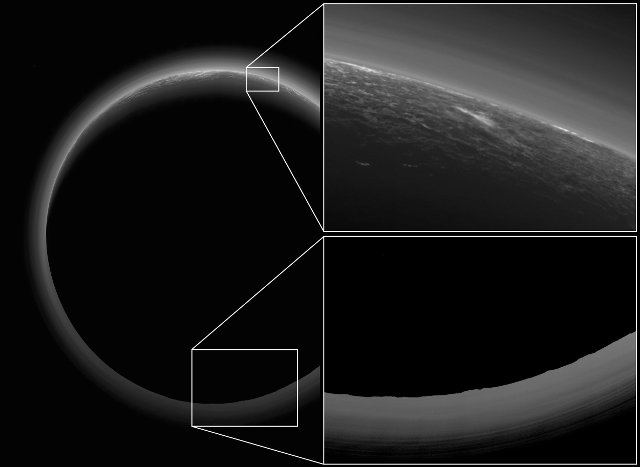
An image obtained by the New Horizons space probe’s Ralph/Multispectral Visual Imaging Camera (MVIC) instrument shows Pluto’s atmosphere from a distance of about 21,550 kilometers (about 13,400 miles). The twilight is due to the fact that it was taken with the Sun on the other side of the dwarf planet.
In the inset at the top right, which shows an area about 230 kilometers (140 miles) long, you can see a white bright formation a few tens of kilometers long. It could be a big cloud made up of methane and would be the first one detected on Pluto. So far their existence has been hypothesized but not verified so these high resolution images are still studied to understand if there are really clouds.
In the inset at the bottom right, which shows an area about 750 kilometers (460 miles) long, the view of Pluto at night shows a rough topography with wide valleys and peaks up to 5 kilometers (about 3 miles) high. The terrain is visible because it’s illuminated from behind by hazes. These are the only high-resolution views of that area of Pluto so are useful to scientists.
Images and other data on Pluto will keep on being transmitted by the New Horizons space probe for a few more months. Gradually, scientists are discovering the secrets of this extraordinary dwarf planet giving us an idea of what activities can take place on celestial bodies so far from the Sun.

Permalink