
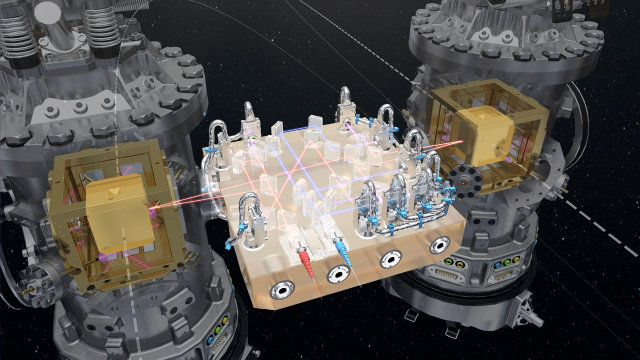
Yesterday ESA held a press conference to announce the results of the LISA Pathfinder space probe’s tests. This demonstration mission of the technologies needed to detect gravitational waves in space has been called a success beyond expectations. The mission team scientists published an article in the journal “Physical Review Letters” which describes the test results.
The LISA (Laser Interferometer Space Antenna) Pathfinder space probe was launched on December 3, 2015 and in early February 2016 reached the area called L1 at about 1.5 million kilometers (almost 1 million miles) from Earth, where there’s a balance of forces suitable for an experiment of this kind. In early March they began the actual tests of the system consisting of two identical cubes shielded from external disturbances and a laser system that measures any movement with an extremely high precision.
Any type of “noise”, due to the solar wind, the sunlight pressure and to other types of external influences must be compensated as much as possible and in any case identified to take account of the measurements. Given the nature of this type of experiment, the real test was to be carried out in space, in conditions impossible to reproduce in a laboratory. That’s why the validity of this project was tested by a demonstrator such as the LISA Pathfinder spacecraft.
The test results were exciting because the accuracy achieved in the measurements was five times greater than that required in the design phase. The relative acceleration between the two cubes is less than one part in ten millionths of a billionth of Earth’s gravity. Put simply, it’s really a great success that shows that this is a right path to the gravitational wave research.
In February 2016, the LIGO experiment announced the detection of gravitational waves but the technologies that will be developed thanks to LISA Pathfinder are a bit different. The waves detected by LIGO have frequencies between 10 Hz and several thousands Hz, only part of the spectrum. In space it will be possible to detect gravitational waves with very low frequencies, between 0.1 and 1 Hz thanks to the possibility to measure incredibly tiny fluctuations.
It’s for this reason that various European national agencies and also NASA have contributed to the LISA Pathfinder mission. Now the problem is in the preparation of the “real” mission, called for the moment eLISA, since the launch is scheduled for 2034. In that case, there will be three probes separated by a few million kilometers. The timeline is long and it would be nice if the LISA Pathfinder tests success convinced ESA to accelerate the next mission.
