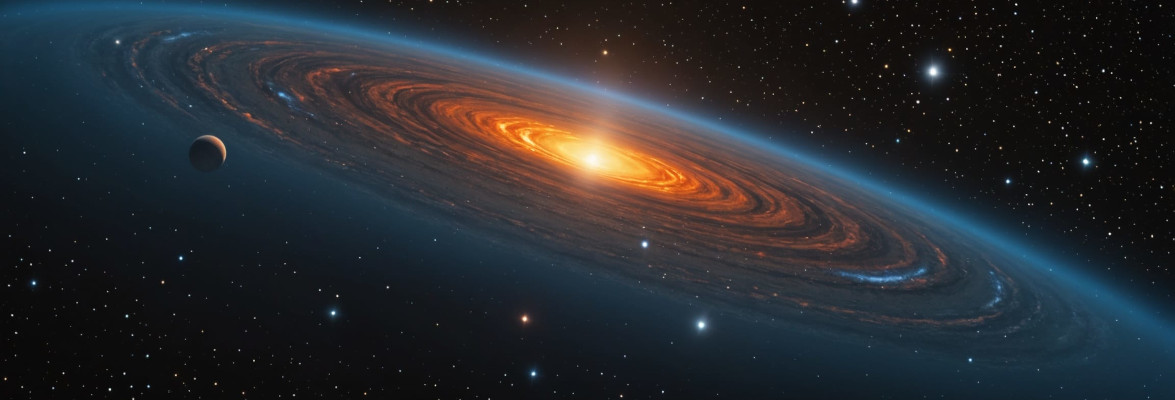

An article published in “The Astrophysical Journal” describes the study of the planet’s characteristics circumbinary Kepler-1647b. By using the Kepler space telescope NASA, a team of scientists at NASA’s Goddard Space Flight Center and the San Diego State University led by Veselin Kostov discovered this planet that orbits two stars. This is not the first case of this kind but it’s the biggest and its year is longer, about three Earth’s years.
Circumbinary planets were made popular by the movie “Star Wars” in which Tatooine, Luke Skywalker’s home planet, is of that type. However, in reality only very recently astronomers have been able to find planets in binary systems orbiting both stars with the first confirmation of the characteristics of the planet Kepler-16b. Tatooine has become an informal name for these circumbinary planets.
The Kepler-1647 system is about 3,700 light years from Earth and has an age close to that of our solar system with its 4.4 billion years. The two stars that make up this system are similar to the Sun: one is a bit larger than the Sun and the other a bit smaller.
In the case of Kepler-1647b the study was long and complex since it began in 2011, with the discovery of a transit, a passage of an exoplanet in front of its star. It took years to reconstruct this planet’s orbit to see that it was actually orbiting both stars of the Kepler-1647 system. This was done also thanks to the network of astronomers of the KELT (Kilodegree Extremely Little Telescope) Follow-Up Network.
The study of Kepler-1647b is interesting because it provides new information on circumbinary planets. So far, the planets of that type discovered were significantly smaller, at most like Saturn, while Kepler-1647b has almost the same size and mass of Jupiter. This planet also has an orbit farther away from its star compared to the others of that type we know.
The orbit issue is important because generally circumbinary planets orbit close to their stars, close to the “critical instability radius”, the proximity limit beyond which the orbit will becomes unstable. Kepler-1647b is much farther away and its year has been estimated at 1,107 Earth days. This might be the first example of a common situation.
It’s interesting to note that Kepler-1647b is within its solar system’s habitable zone. It’s a gas giant so it can’t host life forms similar to those on Earth but it may have moons that we can’t identify which might be habitable. In short, it’s a discovery that offers many new insights for future research.
