June 2016

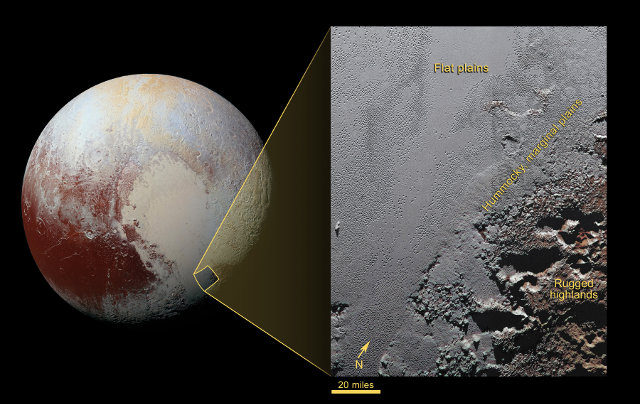
Krun Macula, the borders of Sputnik Planum and their place on Pluto (Image NASA/JHUAPL/SwRI)

NASA released an image of an area of ​​Pluto informally called Krun Macula that shows the variability on the dwarf planet. Obtained by putting together various photographs taken by NASA’s New Horizons space probe during its July 14, 2015 flyby, it shows the border area between the icy plains of the heart-shaped region and the nearby highlands.

Illustration of a hot Jupiter planet with its clouds (Image NASA/JPL-Caltech)

An article published in “The Astrophysical Journal” describes a research about the possible presence of water in the planets of the type called hot Jupiter. Those are gas giants just like Jupiter but orbit very close to their stars and consequently have very high surface temperatures. A team of scientists at NASA’s JPL led by Aishwarya Iyer tried to understand why the atmosphere of some hot Jupiters doesn’t seem to contain water.

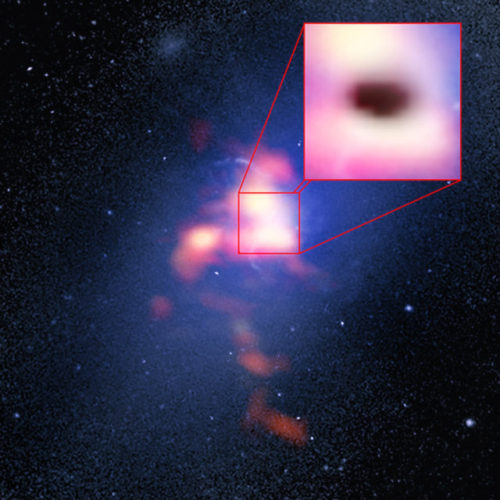
In the background an image taken by the Hubble Space Telescope. In red the gas seen by ALMA (Image B. Saxton (NRAO/AUI/NSF)/G. Tremblay et al./NASA/ESA Hubble/ALMA (ESO/NAOJ/NRAO))

An article published in the journal “Nature” describes the observation of an intergalactic deluge of gases that from large clouds are falling toward the supermassive black hole at the center of a galaxy in the Abell 2597 cluster. By using the ALMA radio telescope a team of astronomers led by Grant Tremblay of Yale University discovered the first evidence that these huge black holes can gorge on gas through chaotic and clumpy rains of giant clouds of very cold molecular gas.

Illustration of the device in the LISA Pathfinder space probe (Image ESA/ATG medialab)

Yesterday ESA held a press conference to announce the results of the LISA Pathfinder space probe’s tests. This demonstration mission of the technologies needed to detect gravitational waves in space has been called a success beyond expectations. The mission team scientists published an article in the journal “Physical Review Letters” which describes the test results.

An area about 400 km (250 miles) long in Pluto's Sputnik Planum region (Image NASA/JHUAPL/SwRI)

Two articles published in the journal “Nature” describe a research about the heart-shaped geological formation on the dwarf planet Pluto. NASA’s New Horizons mission scientists determined various characteristics of the area, informally called Sputnik Planum, explaining that a phenomenon called convection renews its surface over time. Using the images taken by the New Horizons space probe, another research revealed new details on Pluto’s atmosphere.