June 2016

The possible scenario of the impact that created the Moon (a) and the following arrival of water (b) (Image Jessica J. Barnes et al.)

An article published in the journal “Nature Communications” describes a research about the water on the Moon and concluded that it was brought mostly by asteroids that struck it between 4.5 and 4.3 billion years ago. Until now, scientists generally thought that water was transported by comets but according to the international team led by Jessica Barnes of the British Open University things are different.

The galaxy UGC 9391 seen by the Hubble Space Telescope. Cepheid variable are in red circles, a type Ia supernova is marked by a blue cross (Image NASA, ESA, and A. Riess (STScI/JHU))

An article accepted for publication in “The Astrophysical Journal” describes a research based on observations made with the Hubble Space Telescope that suggests that the universe is expanding at a faster rate than expected. A team of astronomers led by Nobel laureate Adam Riess measured the distance of stars in nineteen galaxies with the best accuracy ever achieved to obtain this surprising result.

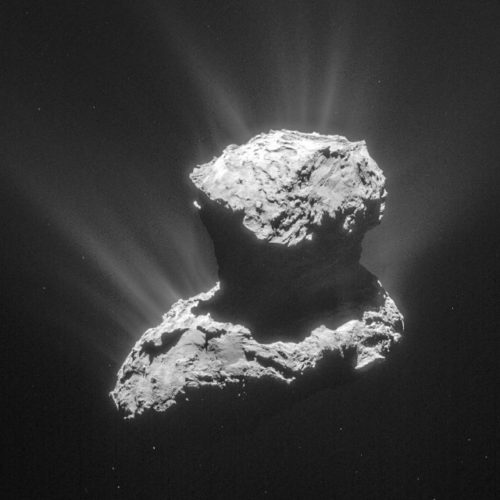
The comet 67P/Churyumov-Gerasimenko photographed on March 25, 2015, one of the moments of the organic molecules detections (Photo ESA/Rosetta/NavCam – CC BY-SA IGO 3.0)

An article published in the journal “Science Advances” describes the discovery of ingredients that are considered key to the origin of life on Earth on the comet 67P/Churyumov-Gerasimenko. In particular, glycine, an amino acid found in proteins, and phosphorus, an element that forms DNA and cell membranes. These observations were made by the ROSINA instrument aboard ESA’s Rosetta space probe.