
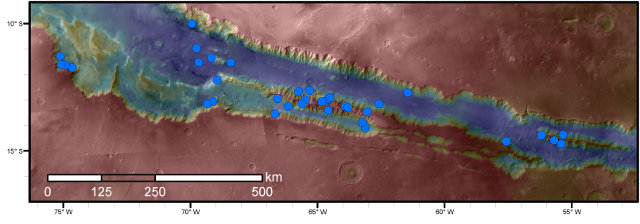
An article published in “Journal of Geophysical Research” describes a research that may have found new traces of liquid water on Mars. A team of researchers led by Matthew Chojnacki of the University of Arizona examined images from NASA’s MRO (Mars Reconnaissance Orbiter) space probe’s HiRise instrument, finding what look like wet sand strips in some regions of the Valles Marineris canyon network.
We’ve known for some time that in the distant past there was liquid water on Mars due to environmental conditions much more similar to Earth than the present ones. In September 2015, the announcement of the discovery of liquid water flows on Mars opened new possibilities connected to the possible presence of life forms. Those are technically called RSL (recurring slope lineae), precisely the wet sand strips containing liquid water.
The photos taken by the MRO space probe’s HiRISE (High Resolution Imaging Science Experiment) camera allowed to examine a number of sites where there are potential RSL. In 41 sites, they were identified ranging from just a few to over a thousand. They seem part of a cycle in which they appear on the slopes during the warm season and disappear when it gets cold.
The spread of RSL in the canyons is greater than previously known. It was important to establish a link between RSL and the presence of water. Many RSL were identified on the inner walls of craters, where it can be explained by the water rising from the ground following the collision of the meteorite that generated those craters. The geology of the canyons in the Valles Marineris is very different.
According to the researchers, the salts present in Mars’ soil can absorb large amounts of water vapor from the atmosphere and return it as salty water that generates the RSL. The problem with this theory is to find a mechanism for the extraction of water from the atmosphere that is efficient enough to generate all the RSL found in the images. In fact, according to calculations, if the RSL discovered in the Valles Marineris canyons are all generated by liquid water they’d need a volume between 10 and 40 times that of an Olympic pool.
This new study also highlighted the fact that the RSL not only make the surface darker but are also associated with materials that move downslope in the canyons. There is some process that happens in those 3D environments due to some interaction between the atmosphere and the surface that doesn’t take place in the same way on flat surfaces.
The scientists are the first to have various doubts about the processes in place because the information are limited. There are other investigations under way, including simulations of the RSL on Earth. There is still much to discover and to understand but slowly the secrets of water on Mars will be revealed.

Permalink
Permalink
Sir,
I believe mars is an un seen paradise.
It is air cooled due it’s atmospheric temp. Is minus 22 c.the planet seems as dessert due to its virginity.
If man handles the planet it would changed as earth.
I think why didn’t nasa sent any seeds of grass ,and plants grow absorbing water from atmosphere?
I could see the statement of scientists that water can see in canyon.awaiting your kind reply.
Permalink
Mars atmosphere is very thin so right now Earth’s plants wouldn’t survive. If you google “Mars terraforming” you can find about projects of turning the red planet into something closer to the Earth though without a magnetic field the atmosphere remains vulnerable to the solar wind.