
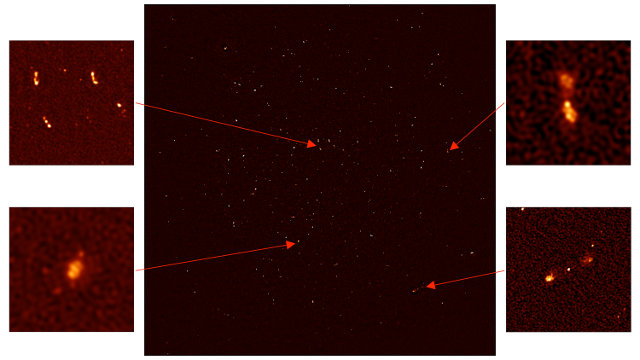
The radio telescope MeerKAT has been activated and the first images of the observations have been released. MeerKAT’s sensitivity was immediately demonstrated because in the observed area 70 galaxies were known but over 1300 have been detected. It’s a great achievement for one of the precursors of the SKA project, the next-generation radio telescope whose activation is scheduled for 2020.
South Africa is one of the sites selected to host the SKA radio telescope’s antennas but it’s a project that will take more years of technological developments. For this reason, some precursor projects are testing various technologies that will be implemented in the SKA and in South Africa the precursor just activated is Meerkat, originally known as the Karoo Array Telescope.
For South Africa it’s an important event because MeerKAT is already a project of the highest scientific and technological level and SKA is one of the largest projects in the history of science and technology. For this reason, the first images captured by MeerKAT were presented by South Africa’s Minister of Science and Technology Naledi Pandor.
This is just the beginning for Meerkat, which is in the stage called AR1 (Array Release 1) where 16 antennas form the radio telescope’s array. In the phase called AR2 the antennas will be 32 and in the one called AR3 the array will be complete with 64 antennas. The AR3 phase is scheduled for late 2017. The antenna activation work is divided into stages so that they can check every time that the various systems work and quickly resolve any issues that may arise.
The AR1 phase quickly proved that it’s possible to perform scientific research at the highest level even when they have only a quarter of the final amount of antennas. The observed sky portion was only 0.1% of the celestial sphere, the same to which last year 4 Meerkat antennas were aimed for a test discovering 50 new galaxies.
The observation with 16 antennas gave results that proved MeerKAT to be already one of the most powerful radio telescopes in the world. The discovery of 1,300 galaxies very distant from Earth is a key scientific milestone for MeerKAT but also for the SKA project. For South Africa there’s a huge commitment at scientific and technological level that involves many national universities and institutions but also an international involvement that will ultimately bring MeerKAT to be integrated into the SKA.
Just over two years ago, there was the presentation of the first image from the radio telescope ASKAP, another SKA precursor. The work that will take in a few years to the activation of the SKA are long and complex and that’s normal because it’s a very ambitious project that will bring radio astronomy to a new level. Meanwhile, precursors such as Meerkat already offer excellent scientific results.
