
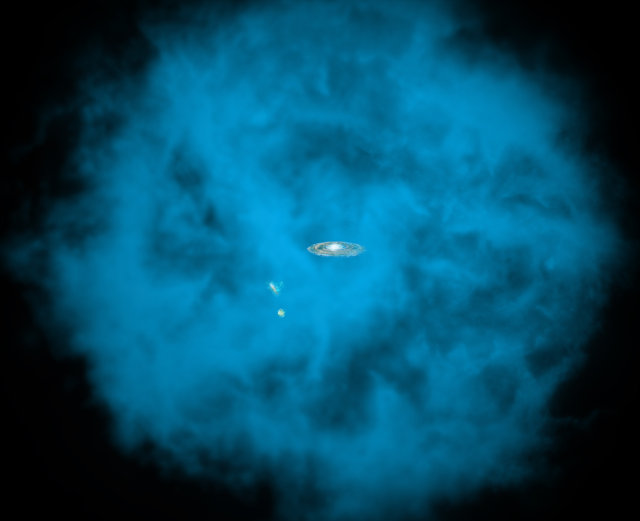
An article published in “The Astrophysical Journal” describes a research on the huge halo of gas surrounding the Milky Way. A group of astronomers at the University of Michigan used data from ESA’s XMM-Newton telescope’s archives to discover that the galaxy’s halo spins in the same direction and at a speed comparable with its disk. This discovery may help better understand the formation of galaxies and solar systems within them.
In September 2012, the use of various space telescopes allowed to collect the data needed to prove that the Milky Way is surrounded by a huge halo of gas which actually also surrounds the small neighboring galaxies, the Large and Small Magellanic Clouds. The researchers also collected some information to estimate the halo’s temperature, extent and mass.
This new research funded by NASA allowed to make a step forward in the understanding of the halo that surrounds the Milky Way. Analyzing the shift in wavelengths of light caused by the Doppler effect due to high-speed movements, the researchers used the lines of the very hot oxygen present in the halo to measure the shift.
The result is that the halo moves in the same direction of the Milky Way and with a similar speed. In fact, the speed of the halo was measured at around 640,000 kph (about 400,000 mph), while that of the Milky Way disk’s spin is about 870,000 kph (540,000 mph). It’s a surprising discovery because it was believed that the halo was still and only the galactic disk was spinning.
According to Edmund Hodges-Kluck, the article’s main author, it’s a significant clue to the formation of the Milky Way because it tells us that this very hot atmosphere is the original source of much of the material in the galactic disk. Understanding its characteristics means taking a step forward in understanding the processes that led to the formation of the Milky Way and therefore of its stars and its planets but also to better understand its future evolution.
This discovery can also be a help in the search for the missing matter. Scientists have long known that visible matter is much less than expected in a galaxy. In part, this difference is explained with the presence of dark matter but there’s also a part of baryonic matter and at least a part is in the halo. It’s for these reasons that research were carried out in recent years and the halo, not only the Milky Way’s, will keep on being studied.
